Chapter 1: The Ghost in the Linoleum Corridors
The phone call came at precisely 2:14 PM, fracturing the heavy, suffocating silence of my sterile, sparsely furnished apartment. When I answered, the voice of Mrs. Gable, the elderly secretary at Oak Creek Elementary, crackled through the receiver, heavy with a profound, terrifying confusion. “Dr. Vance? I… I don’t understand how this is possible, but… your daughter is in the principal’s office. She says she’s waiting for you.”
I stopped breathing. That was the required physiological response, the biological absolute of a mother who had watched a tiny, white casket lowered into the frozen, unforgiving earth exactly two years, four months, and sixteen days ago. I forced my hand to tremble violently, knocking a stack of heavily redacted research files off my kitchen counter. I gasped, a ragged, wet sound of pure, unadulterated shock, and slammed the phone down. I grabbed my keys, my heavy wool trench coat, and sprinted out the door, playing the role of the shattered, hysterical woman to absolute perfection.
The drive to the elementary school was a blur of gray asphalt and torrential, biting autumn rain. The windshield wipers slapped rhythmically against the glass, a frantic metronome counting down to the collision of two entirely different realities. My knuckles were stark white as I gripped the leather steering wheel, my mind meticulously reviewing the architectural blueprints of Oak Creek Elementary, the emergency exit routes, and the blind spots in their outdated security camera network. I was supposed to be a woman blinded by the agonizing resurrection of her deepest trauma. I was supposed to be shaking with a blinding, irrational rage at the sick, twisted prank someone was playing on a grieving mother.
But beneath the manufactured hyperventilation and the tears I forced to well in my eyes, my resting heart rate was a steady, glacial sixty beats per minute.
I slammed my car into a loading zone outside the brick facade of the school, leaving the engine idling and the driver’s side door hanging wide open to the storm. I sprinted up the concrete steps, my boots slipping on the wet leaves, and shoved my entire body weight against the heavy, reinforced oak double doors. The familiar, nostalgic scents of industrial floor wax, stale construction paper, and institutional disinfectant slammed into me, instantly transporting me back to a life that no longer existed. I didn’t stop at the visitor’s desk. I ignored the startled shout of the security guard stationed near the cafeteria. I tore down the main corridor, my boots squeaking violently against the polished linoleum, my breath coming in jagged, theatrical gasps.
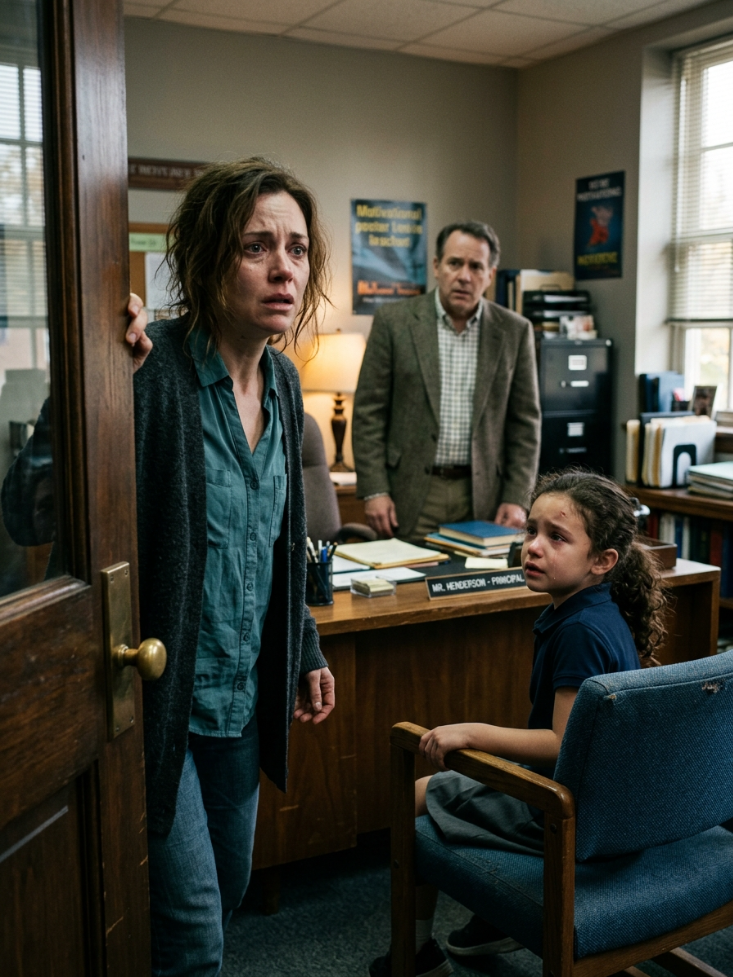
I reached the frosted glass door of the administrative suite and threw it open. Mrs. Gable was standing behind her laminate counter, her face drained of all blood, a crumpled tissue clutched in her trembling hands. She looked at me, her eyes wide with a terrifying, uncomprehending horror, and simply pointed a shaking finger toward the closed, heavy mahogany door of the principal’s office.
I didn’t wait for permission. I crossed the reception area in three massive strides, grabbed the brass handle, and shoved the heavy door inward, my mouth opening to unleash a scream of absolute, devastating maternal fury.
The scream died in my throat. The performance momentarily slipped, replaced by a genuine, microscopic tremor of awe at the sheer, terrifying audacity of their bio-engineering division.
Standing in the center of the plush, dimly lit office, bathed in the gray light filtering through the rain-streaked blinds, was a small, fragile silhouette. She was wearing a yellow raincoat, the exact same brand and color I had bought two and a half years ago. She slowly turned around to face me. The golden-blonde hair, falling in soft, untidy waves across her forehead. The pale, luminous green eyes. The dusting of seven faint freckles across the bridge of her nose. And there, resting just beneath the left corner of her bottom lip, the exact same tiny, crescent-shaped scar she had gotten from falling off a tricycle at age four.
“Mommy,” she whispered, her voice a fragile, musical chime that shattered the air in the room, her lower lip trembling with perfectly calibrated, manufactured fear.
I dropped to my knees, the impact sending a jarring shockwave up my shins. I reached my hands out, letting the tears finally spill over my eyelashes, entirely consumed by the overwhelming, impossible reality of the ghost standing before me. But as my fingers brushed the damp, synthetic fabric of her yellow raincoat, I knew exactly who had orchestrated this theatrical nightmare, and I knew exactly who was waiting in the shadows behind the principal’s massive oak desk.
Chapter 2: The Doppelgänger’s Gaze
I pulled the little girl into my chest, burying my face in the crook of her neck. She smelled like rain and Johnson & Johnson baby shampoo, a scent profile that had undoubtedly been synthesized and applied in a sterile laboratory environment mere hours ago. Her small, fragile arms wrapped hesitantly around my neck. Her body temperature was a flawless 98.6 degrees, her pulse a rapid, terrified flutter against my collarbone. To any medical professional, to any biometric scanner, and certainly to any grieving mother, she was Lily. She was the absolute, undeniable resurrection of the child I had lost.
But I was not just a mother. I was the former lead architect of the Aethelgard Corporation’s proprietary cellular regeneration division. I knew the microscopic imperfections in their cloning matrix. I felt the slight, almost imperceptible rigidity in the synthetic cartilage of her earlobe beneath my thumb. I noted the absence of the faint, rhythmic wheeze in her left lung—a mild asthmatic condition the original Lily had developed, which the corporate geneticists had likely edited out in their pursuit of the “perfect” biological replica.
“How touching,” a smooth, baritone voice echoed from the shadowed corner of the office, entirely devoid of human empathy. “The prodigal mother, reunited with her lost lamb. It brings a tear to the eye, doesn’t it, Dr. Vance?”
I kept my arms wrapped tightly around the clone, burying my face in her shoulder to hide the cold, calculating smile that threatened to curve my lips. I let out a long, shuddering sob, playing the role of the broken, cornered prey. Slowly, agonizingly, I turned my head to look past the heavy oak desk.
Stepping out of the shadows, wearing a bespoke, charcoal-gray Brioni suit that cost more than the annual budget of the elementary school, was Marcus Thorne. He was the Director of Covert Operations for Aethelgard, a man whose entire existence was dedicated to erasing corporate liabilities and securing intellectual property through intimidation, extortion, and blood. His silver hair was slicked back with severe precision, and his pale, reptilian eyes locked onto me with a suffocating, arrogant triumph. Sitting in the leather chair behind the desk, entirely unconscious and bound with industrial zip-ties, was the actual principal of the school.
“What… what is this?” I stammered, my voice cracking perfectly, clutching the little girl closer to my chest. “Marcus? What have you done? Lily is dead. I buried her. I watched them lower her into the ground.”
Marcus chuckled, a dry, rasping sound like sandpaper on concrete. He stepped forward, walking around the desk, his expensive leather shoes clicking softly against the hardwood floor. “You buried an empty, weighted casket, Evelyn,” he corrected smoothly, leaning against the edge of the mahogany desk and crossing his arms. “You were very thorough. The falsified autopsy report, the bribed mortician, the staged car accident. It took us eighteen months to unravel the smoke and mirrors you left behind. You realized that Lily’s unique genetic mutation—the spontaneous cellular regeneration sequence in her marrow—was worth trillions to our board of directors. You knew we were going to harvest her. So, you hid her.”
He looked down at the little girl in my arms with profound, clinical disgust. “We haven’t found the original yet. You hid her well. But you made a critical error, Evelyn. Before you fled the corporation, you left a hairbrush in your quarters. We extracted the follicle. We sequenced the DNA. And we spent a billion dollars accelerating the gestation and growth cycle in our off-book facility in Zurich. We built you a new Lily. And we brought her here today to deliver a very simple ultimatum.”
I looked up at him, my eyes wide, performing the exact mixture of terror and desperation he expected to see. “You’re insane. You can’t just walk into a public school…”
“I can walk anywhere I please, Evelyn. I own the local police precinct. The perimeter of this school is currently locked down by my private security contractors,” Marcus interrupted, his voice dropping into a dangerous, icy register. “Here is how this plays out. You are going to stand up, walk out to my vehicle, and return to the Aethelgard laboratory. You will resume your work on the regeneration sequence, and you will hand over the original child. If you refuse, or if you attempt to run, my operatives will terminate this clone right in front of you. And then, we will burn this entire city to the ground until we find the real Lily, and we will dissect her while you watch.”
He reached into the interior pocket of his tailored jacket, pulling out a sleek, black, encrypted smartphone, tapping the screen to initiate a localized jammer that would block all external cellular signals. He believed he possessed absolute, unquestionable dominance. He believed he had maneuvered me into an inescapable, psychological corner, using the face of my child as a weapon.
“You built a cage out of my grief, Marcus,” I whispered, my voice trembling, tears tracking down my cheeks as I stroked the clone’s synthetic golden hair.
“I am a pragmatic man, Evelyn,” Marcus smiled, a cold, predatory baring of teeth. “Now. Stand up. The helicopter is waiting.”
Part 2: The school secretary called to say my dead daughter was waiting in the principal’s office, and I rushed over pretending to be a terrified, grieving mother. The corporate assassins thought they were using her clone as the ultimate bait to lure me into a trap, but they didn’t know I engineered the snare.
About The Author