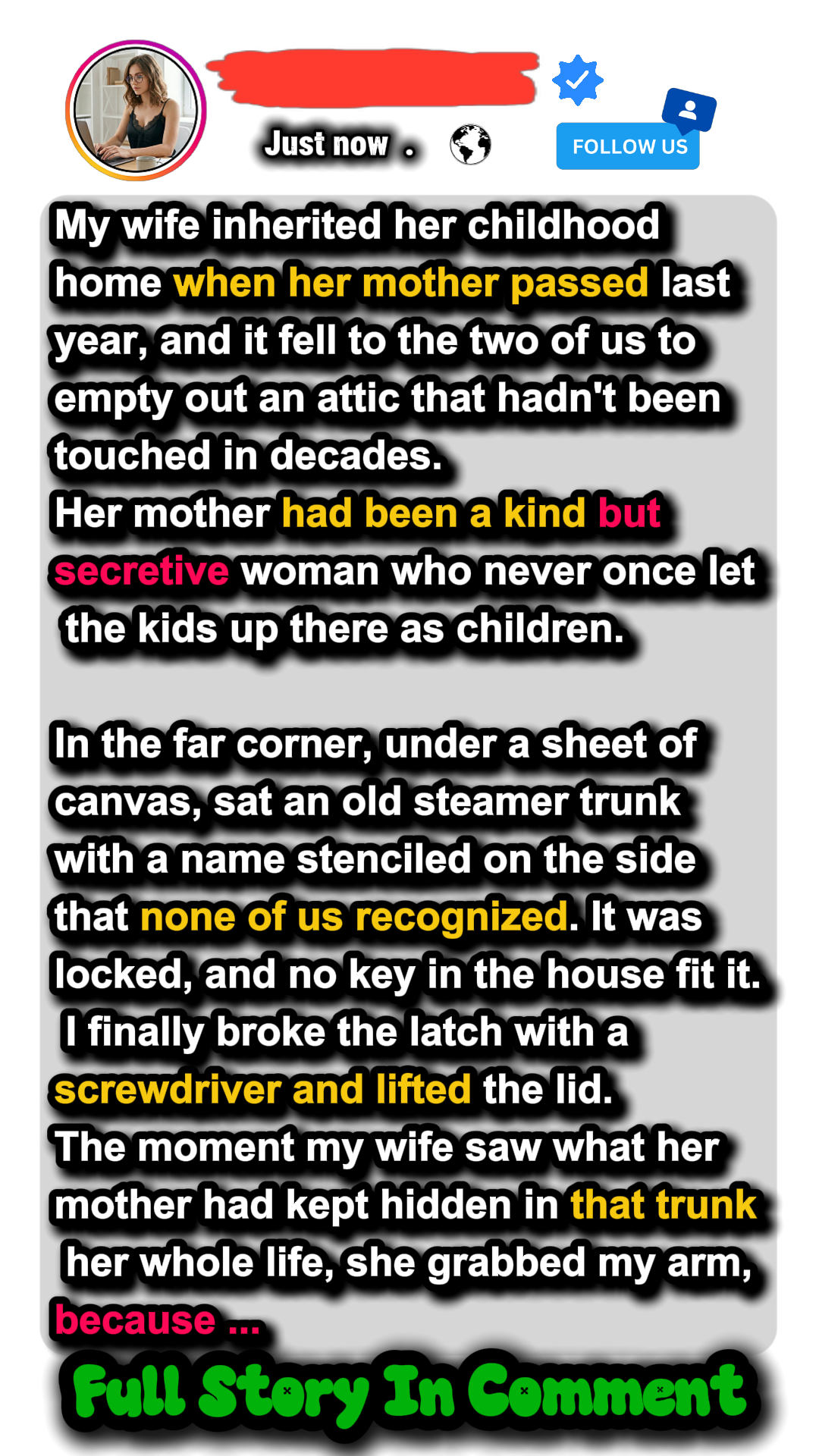
MY WIFE INHERITED HER CHILDHOOD HOME AFTER HER MOTHER PASSED AWAY, BUT WHEN WE FINALLY OPENED THE ATTIC SHE HAD KEPT LOCKED FOR DECADES AND DISCOVERED A STRANGER’S NAME ON AN OLD STEAMER TRUNK, WE UNCOVERED A SECRET HER MOTHER HAD PROTECTED HER ENTIRE LIFE—ONE THAT CHANGED EVERYTHING MY WIFE BELIEVED ABOUT HER FAMILY
My mother-in-law, Margaret, died at eighty-eight on a quiet afternoon in early October.
She passed away in the same little farmhouse where she’d lived for nearly sixty years.
The same house where she’d raised my wife, Carol.
The same house where every Christmas smelled like cinnamon and fresh bread.
Where every birthday cake came from the same chipped mixing bowl.
Where every photograph on the mantel seemed to tell part of a story.
Margaret was one of those women everyone described the same way.
Kind.
Patient.
Dependable.
She remembered everyone’s favorite pie.
She knitted blankets for babies she barely knew.
She never forgot an anniversary.
But there was one thing everyone also knew.
Nobody went into the attic.
Not ever.
When Carol and her brothers were children, the attic door remained locked.
If they asked what was up there, Margaret would simply smile.
“Old things.”
Nothing more.
As adults, they joked that it was probably full of broken furniture and Christmas decorations.
No one pushed the subject.
After her funeral, Carol’s brothers took whatever family keepsakes they wanted.
One chose their father’s tools.
Another wanted the old hunting rifles.
Carol inherited the house.
That left the attic.
“I guess we finally find out what was so important,” she said one Saturday morning.
The narrow wooden stairs creaked beneath our feet.
Dust floated through beams of sunlight leaking from the small gable window.
The attic smelled of cedar and old paper.
Rows of neatly labeled boxes lined one wall.
Christmas ornaments.
Baby clothes.
School papers.
Exactly the sort of things you’d expect.
For nearly two hours, nothing surprised us.
Until I noticed something hidden beneath an old canvas tarp in the far corner.
It wasn’t a storage box.
It was an old steamer trunk.
Dark green.
Leather corners cracked with age.
Brass hardware dulled by time.
Painted across the side, in faded white letters, was a name neither of us recognized.
EVELYN MORROW.
Carol frowned.
“Who’s Evelyn Morrow?”
I shrugged.
“No idea.”
The trunk was locked.
We searched the house for nearly an hour.
Every key ring.
Every junk drawer.
Every old tin.
Nothing fit.
Finally I returned with a flat-head screwdriver.
“I’m sorry, Margaret.”
The latch resisted.
Then snapped.
The lid opened with a long, dry groan.
Carol leaned beside me.
Then immediately grabbed my arm.
Hard.
“Oh my God.”
Inside wasn’t treasure.
Or money.
Or jewelry.
It was an entire life.
Neatly folded baby blankets.
Tiny dresses.
Children’s shoes.
Bundles of letters tied with ribbon.
A leather-bound journal.
Photographs.
And resting on top of everything…
A framed black-and-white portrait of a young woman.
The woman looked startlingly familiar.
Not because I’d ever seen her before.
Because she looked exactly like Carol.
The same eyes.
The same smile.
The same unmistakable dimple in her left cheek.
Carol stared silently.
Finally she whispered,
“She looks like… me.”
Neither of us touched anything for several moments.
Then Carol carefully lifted the photograph.
A note tucked behind the frame fluttered onto the blanket below.
In Margaret’s handwriting.
“If you have opened this, then I am finally gone.”
Carol’s breathing became uneven.
She unfolded the letter.
“My darling children,
There is something I should have told you years ago.
I lacked the courage.”
The room suddenly felt much smaller.
Margaret explained that Evelyn Morrow had been her older sister.
Not a cousin.
Not a family friend.
A sister.
Carol looked at me in disbelief.
“My mother never had a sister.”
Apparently she had.
Born twelve years before Margaret.
Brilliant.
Funny.
Restless.
The letters painted a vivid picture of a young woman who loved music, read constantly, and dreamed of becoming a teacher.
Then tragedy struck.
In 1958, Evelyn was diagnosed with what doctors then called “nervous instability.”
Today, the symptoms described in Margaret’s letter sounded far more like severe bipolar disorder.
But treatment in those years was very different.
Families often hid mental illness.
Ashamed.
Afraid.
Margaret’s parents made a devastating decision.
They committed Evelyn to a state psychiatric hospital.
Temporarily.
At least that was the intention.
Temporary became permanent.
The family stopped talking about her.
Neighbors were told she’d moved away.
Photographs disappeared.
Letters were destroyed.
Except…
Margaret hadn’t destroyed hers.
She had secretly visited Evelyn every month for thirty-three years.
Every month.
Without telling anyone.
Not even her husband.
Not even her children.
The trunk contained every letter Evelyn had written.
Every birthday card.
Every handmade Christmas ornament.
Every watercolor painting.
Every photograph from those visits.
Carol covered her mouth.
“My mother drove two hours every month…”
I nodded.
“…and never told anyone.”
Then we found the journal.
Margaret had documented every visit.
Sometimes only a paragraph.
Sometimes several pages.
She described Evelyn’s good days.
Her difficult days.
The way she always remembered birthdays.
The songs they still sang together.
The books they read aloud.
The heartbreaking moments when Evelyn forgot where she was.
The entries continued year after year.
Until one final page.
Evelyn died in 1991.
Margaret was holding her hand.
There was another envelope.
Addressed specifically to Carol.
She opened it slowly.
“My sweet girl,
If you’re reading this, you’ve learned about Aunt Evelyn.
You may wonder why I never told you.
The truth is complicated.
When I was young, families believed silence protected people.
By the time I knew they were wrong, I had spent so many years keeping the secret that I no longer knew how to break it.
I was afraid you would think I was ashamed of her.
I never was.
I admired her.
She fought an illness none of us understood.
She remained gentle through unimaginable loneliness.
She deserved better than the world gave her.
Please remember her not as someone hidden away…
…but as your aunt.
Because she always remembered you.
Even though you never knew her.”
Carol stopped reading.
Tears rolled silently down her face.
“She knew me?”
I looked through the trunk.
Near the bottom sat a small wrapped package.
The tag read:
For Carol.
To be opened when she is grown.
Inside was a hand-knit blue sweater.
Beautifully made.
Tiny embroidered flowers around the collar.
Attached was a note in shaky handwriting.
“I hope someday we meet.”
Signed,
Aunt Evelyn.
Carol held the sweater against her chest.
“I never even knew she existed.”
Over the next several months we searched for records.
We learned that the old hospital had closed years earlier.
Most patient files had been archived.
With Margaret’s journals, family photographs, and official documents, we pieced together Evelyn’s life more completely than anyone else in the family ever had.
At Thanksgiving, Carol invited her brothers over.
She laid the trunk on the dining room table.
One by one they read the letters.
The room remained quiet for hours.
Their oldest brother finally looked up.
“I always wondered why Mom disappeared one Saturday every month.”
“So did I,” Carol answered softly.
“We finally know.”
The following spring we visited Evelyn’s grave.
It sat in a quiet cemetery only fifteen minutes from the hospital.
Fresh flowers already rested there.
We later learned Margaret had arranged for the florist to deliver them every month for twenty-five years after Evelyn’s death.
Even after she could no longer make the drive herself.
Standing there, Carol smiled through tears.
“My mother spent her whole life making sure nobody forgot her sister.”
I squeezed her hand.
“And now nobody will.”
The trunk no longer sits hidden in the attic.
It rests in our living room.
Not because it’s valuable.
Not because it’s beautiful.
But because inside it is the proof that love sometimes survives in silence.
That even when fear convinces people to hide the truth, kindness can keep showing up anyway.
Every month.
For thirty-three years.
Until the day there is finally someone left to tell the story.
THE END
About The Author