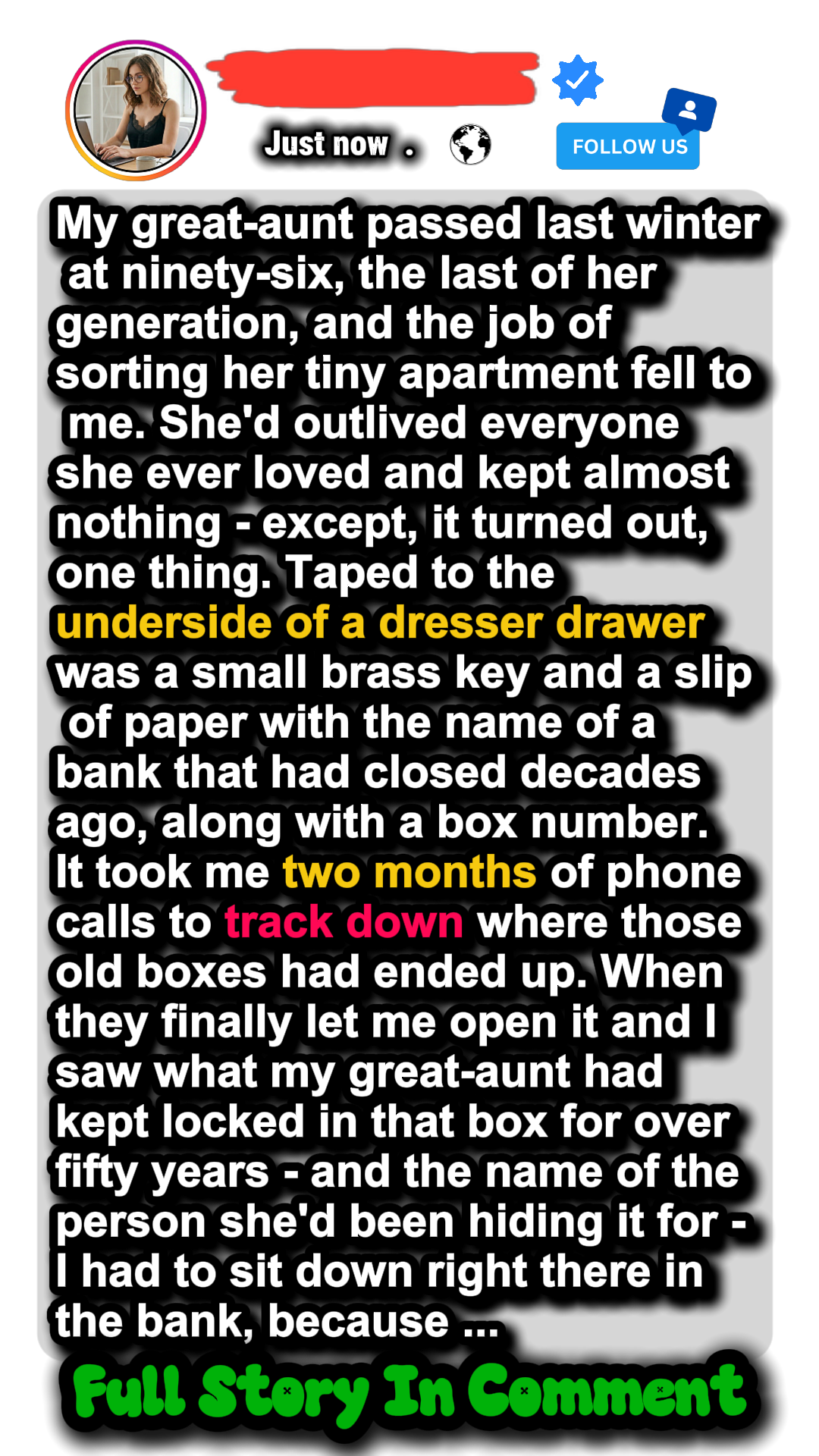
MY GREAT-AUNT DIED AT NINETY-SIX LEAVING ALMOST NOTHING BEHIND EXCEPT A BRASS KEY HIDDEN UNDER A DRESSER DRAWER, AND WHEN I FINALLY OPENED THE SAFE-DEPOSIT BOX SHE HAD KEPT SECRET FOR MORE THAN FIFTY YEARS, I DISCOVERED A LOVE STORY, A BETRAYAL, AND A NAME THAT CHANGED EVERYTHING I THOUGHT I KNEW ABOUT MY FAMILY
My great-aunt Eleanor died on a gray January morning.
The nursing home called just after sunrise.
By the time I arrived, she was already gone.
Peaceful.
Quiet.
Exactly the way she had lived.
At ninety-six, she’d become something of a family legend.
The last surviving member of her generation.
The keeper of stories.
The woman who remembered everyone’s birthdays, anniversaries, and childhood embarrassments.
And then suddenly there was no one left who remembered those things.
No one except me.
At least that’s what I thought.
Since I was her closest living relative, the responsibility of settling her affairs landed in my lap.
It wasn’t much.
A tiny apartment.
A modest bank account.
A few pieces of furniture.
Several boxes of photographs.
Nothing extraordinary.
In fact, the thing everyone remembered most about Aunt Eleanor was how little she owned.
She never married.
Never had children.
Never bought a house.
She spent most of her life working as a librarian.
After retirement, she lived quietly and comfortably, reading books and tending a balcony garden.
When I began cleaning out her apartment, I expected nothing more dramatic than old photographs and forgotten receipts.
I was wrong.
Three weeks into the process, I was removing drawers from an antique dresser she’d owned for decades.
One drawer stuck badly.
When I finally pulled it free and flipped it over, something metallic clinked onto the floor.
A small brass key.
No label.
No markings.
Just a worn brass key taped beneath the drawer.
Beside it was a folded slip of paper.
On it, written in Eleanor’s careful handwriting, were only three things:
First National Trust Bank
Box 247
For when I’m gone.
I stared at the note.
Confused.
The bank no longer existed.
I checked online.
It had merged with another institution nearly thirty years earlier.
Most people would have stopped there.
But Eleanor wasn’t the type to hide meaningless things.
If she’d concealed a key for decades, there was a reason.
So I started digging.
One phone call became five.
Five became twenty.
Records had been transferred.
Archives moved.
Branches closed.
Documents stored off-site.
Weeks passed.
Then months.
Several times I almost gave up.
But something kept pulling me forward.
Maybe curiosity.
Maybe grief.
Maybe the feeling that Eleanor wanted this found.
Finally, after nearly two months, a woman from a regional banking office called me back.
“We found the records.”
My heart immediately sped up.
“There is a safe-deposit box.”
I sat up straighter.
“It still exists?”
“Yes.”
I could barely believe it.
Apparently the contents had been preserved through multiple mergers.
Because the rental fees had been prepaid decades earlier through a trust arrangement, nobody had ever opened it.
Nobody had ever touched it.
For over fifty years.
The following week I drove three hours to the branch where the box had been transferred.
The manager verified my documents.
Confirmed the death certificate.
Reviewed the estate paperwork.
Then led me into the vault.
The room felt colder than the rest of the bank.
Rows upon rows of metal boxes lined the walls.
Eventually she stopped.
“Box 247.”
The brass key fit perfectly.
A sound I can still remember echoed softly inside the vault.
Click.
The lock turned.
The manager removed the box and placed it in a private room.
Then she left.
Suddenly I was alone.
Staring at a metal container that had remained unopened for more than half a century.
I took a deep breath.
Then lifted the lid.
Inside were only three items.
A bundle of letters tied together with faded blue ribbon.
A small leather journal.
And a sealed envelope.
The envelope sat on top.
Written across the front in Eleanor’s handwriting were six words.
FOR THOMAS IF HE EVER RETURNS
I froze.
Thomas.
The name meant nothing to me.
At first.
Then something clicked.
A vague memory.
A story I’d heard as a child.
A man named Thomas.
A fiancé.
A soldier.
Someone who had disappeared during the Vietnam War.
I lowered myself into the chair.
My hands suddenly felt weak.
Carefully, I opened the journal first.
The first page was dated 1968.
The entries that followed were deeply personal.
Painfully honest.
And all of them revolved around one person.
Thomas Hale.
Eleanor’s fiancé.
The man she had loved.
The man she had intended to marry.
According to the journal, Thomas had been deployed overseas six months before their wedding.
Then one day the letters stopped.
Military officials later informed Eleanor that Thomas was presumed dead.
Missing in action.
No body recovered.
No certainty.
Just gone.
Everyone encouraged her to move on.
Her family.
Her friends.
Even Thomas’s parents.
Years passed.
Then decades.
Eleanor never married.
Never seriously dated.
Never spoke much about him.
Reading those pages felt like watching someone’s heart break in slow motion.
Yet that wasn’t what made me sit down.
That happened when I opened the sealed envelope.
Inside was a single letter.
Dated 1974.
Six years after Thomas disappeared.
I read the first sentence.
Then read it again.
And again.
Because it didn’t seem possible.
Eleanor had received a letter from Thomas.
He was alive.
Alive.
Six years after being declared dead.
The letter explained everything.
He had been captured.
Held overseas.
Released years later.
But by the time he returned to the United States, he discovered something devastating.
Eleanor’s family had told him she’d moved on.
Married.
Started a new life.
The lie had been intentional.
Thomas’s father had arranged it.
According to the letter, he believed Eleanor deserved a chance to rebuild her life.
He didn’t want old wounds reopened.
So he convinced Thomas she was gone forever.
Meanwhile, Eleanor had been told Thomas was dead.
Two people.
Still alive.
Still in love.
Separated by a lie.
For six years.
The letter ended with a promise.
“I don’t know if this reaches you. I don’t know if you’ve moved on. But if there’s any chance you still remember me, I’ll wait.”
I stared at the page.
My chest hurt.
Because I already knew the answer.
Eleanor never received it.
The envelope containing Thomas’s letter was still sealed.
Unopened.
Unread.
For fifty-two years.
Somehow it had ended up inside the safe-deposit box before she ever saw it.
I searched frantically through the remaining documents.
Eventually I found the explanation.
Another envelope.
Addressed to Thomas.
Returned to sender.
Inside were Eleanor’s own letters.
Dozens of them.
All unanswered.
All returned.
The truth emerged piece by piece.
Thomas’s father had intercepted both sides.
Every letter.
Every attempt.
Every hope of reunion.
For years.
Neither of them knew.
Neither stopped loving the other.
And neither understood why the other had seemingly disappeared.
I sat there in stunned silence.
A lifetime stolen by somebody else’s decision.
A future erased.
A marriage that never happened.
Children that never existed.
Entire generations lost.
All because one man believed he knew what was best.
Then I noticed something else.
Tucked inside the journal was a newspaper clipping.
Only a few years old.
An obituary.
Thomas Hale.
Died at ninety-one.
Three years earlier.
My throat tightened.
He had lived a full life.
Married eventually.
Had children.
Grandchildren.
A long career.
Yet according to the final pages of Eleanor’s journal, she had continued wondering about him until the end.
Not obsessively.
Not bitterly.
Just quietly.
Like someone carrying an unanswered question.
The final journal entry was written less than a year before her death.
The handwriting was shaky.
Uneven.
But clear.
“If there is another life after this one, I hope somebody finally tells us the truth.”
I couldn’t stop crying.
Right there in the bank.
Not loud sobs.
Just tears.
Because suddenly Eleanor’s life looked completely different.
Not lonely.
Not empty.
Not unfinished.
She had loved deeply enough to carry that love for seventy years.
And somehow that felt both heartbreaking and beautiful.
Several weeks later, I tracked down Thomas’s family.
His daughter answered my call.
At first she was suspicious.
Then curious.
Then emotional.
When I explained what I’d found, there was a long silence.
Finally she whispered:
“My father talked about an Eleanor until the day he died.”
We met a month later.
I brought copies of everything.
The letters.
The journal.
The photographs.
Together we pieced together a story that should have ended very differently.
A story neither family had ever known.
When I returned home that evening, I thought about the tiny brass key hidden beneath a dresser drawer.
The secret Eleanor had protected for half a century.
Not because she wanted to hide the truth.
But because she couldn’t bear to throw away the last evidence that someone had once loved her enough to wait.
And in the end, after all those years, she finally succeeded in what she had hoped for.
The truth was found.
The story was told.
And two people separated by decades of silence were remembered together at last.
THE END
About The Author