Nobody from my family showed up to my wedding. Not one person. Not my father. Not my mother. Not my brother. Not my sister. Not a single cousin, aunt, uncle, or grandparent. Not even a call. Not even a message.
The ceremony started at four in the afternoon under a white floral arch at a small vineyard outside Asheville. My husband, Aaron, stood waiting for me in a navy suit, smiling like I was the only person in the world. Behind him, his family filled the chairs.
His mother cried before I even reached the aisle.
His father stood proudly with both hands folded over his cane.
His sisters waved at me softly, trying to make me laugh because they knew I had spent the entire morning checking my phone.
I kept thinking someone from my side would arrive late.
Maybe my mother would rush in wearing too much perfume and apologize.
Maybe my father would appear in the back row with his stubborn face and pretend traffic was the problem.
Maybe my brother would text something stupid like, Save me cake.
But nothing came.
The chairs on my side stayed empty.
Every one of them.
White ribbons moved in the breeze, tied to seats nobody used.
I walked down the aisle alone.
Not because I wanted to make a statement.
Because there was no one there to walk with me.
My father had promised he would.
Two weeks before the wedding, he said, “I’ll be there, Emma. Don’t worry.”
My mother said, “Of course we’re coming, sweetheart.”
My brother Travis said he might be late because of work.
My sister Hailey said she had already bought a dress.
All lies.
They did not come because I refused to postpone my wedding so Travis could announce his engagement first.
That was the real reason.
My brother had always been the center of my family’s universe.
When he needed money, everyone found it.
When he made mistakes, everyone forgave him.
When he hurt people, everyone explained it away.
I was the responsible daughter.
The quiet daughter.
The one who sent money when rent was short.
The one who paid my mother’s medical bills.
The one who co-signed Travis’s first car because my father begged me with tears in his eyes.
The one who helped Hailey with tuition and never asked to be praised for it.
But when I finally chose something for myself, my family treated it like betrayal.
“Your brother is getting engaged soon,” my father told me three months before the wedding. “It would be selfish to take attention from him right now.”
I laughed because I thought he was joking.
He was not.
“Dad, my wedding has been planned for a year.”
“Family needs to move together,” he said. “You always have to do things your way.”
“My way is getting married on the date I already paid for.”
He sighed like I was difficult.
“Fine. Do what you want.”
So I did.
And they punished me with empty chairs.
Aaron noticed, of course.
Everyone noticed.
But nobody said anything cruel.
His mother moved a few relatives to sit on my side so it would not look so abandoned in the photos.
That kindness nearly broke me.
During the reception, Aaron held me close and whispered, “You are not unloved because they failed you.”
I cried into his jacket.
Not loudly.
Not dramatically.
Just enough for him to feel it.
We went on a short honeymoon to the coast and tried to enjoy it.
Aaron never pressured me to talk about my family.
He let me sit on the balcony with coffee and silence.
He took pictures of sunsets.
He ordered extra dessert.
He made me laugh when I could.
But every morning, I checked my phone.
Still nothing.
No apology.
No explanation.
No “Congratulations.”
No “How was the wedding?”
Nothing.
Then, three weeks later, my father texted as if nothing had happened.
We need to raise $8,400 for your brother’s wedding.
I stared at the screen for so long that Aaron looked up from his laptop.
“What happened?”
I showed him.
His face changed.
Not anger first.
Disbelief.
Then anger.
“They ignored your wedding and now they’re asking for money for Travis’s?”
I read the message again.
We need to raise.
Not would you help.
Not I’m sorry.
Not are you okay.
We need.
As if I were a family bank account that had briefly malfunctioned.
My thumb hovered over the screen.
For years, I had answered those messages immediately.
How much?
When do you need it?
I’ll send what I can.
This time, I opened my banking app.
I transferred one dollar.
In the note field, I typed:
Best wishes.
Then I sent it.
Aaron stared at me.
I placed the phone facedown on the table.
Then I turned to my husband and said, “Change every lock in the house.”
He did not ask why.
He only stood up and said, “Already calling.”
The response came faster than I expected.
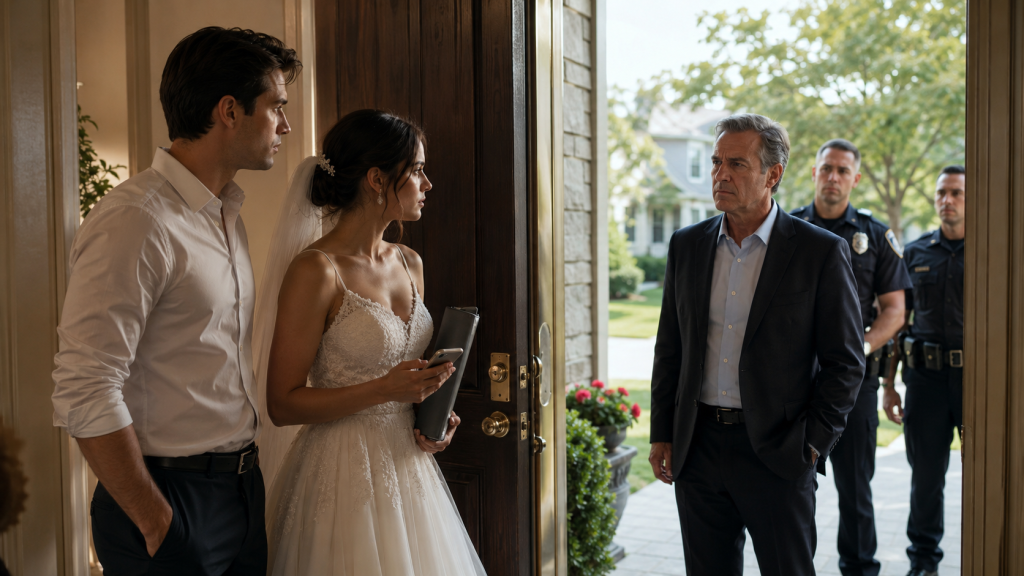
That same afternoon, my father showed up at my door with the police standing right behind him.
And in that moment, I realized this was not over.
My father stood on my porch pointing at me like I was the criminal.
“Officer, this is my daughter,” he said. “She stole family money and locked us out of property that belongs to us.”
I almost laughed.
But Aaron gently touched my back, reminding me to breathe.
The officer turned to me.
“Ma’am, can you explain what’s going on?”
I opened the folder I had prepared the night before.
Maybe some part of me knew my father would not accept a boundary without trying to break it.
“The house is in my name and my husband’s name,” I said. “My family has never lived here, paid for it, or contributed one dollar.”
My father’s face tightened.
“She’s lying. We helped raise her.”
I looked at him.
“You didn’t even come to my wedding.”
Silence fell.
Even the officer looked uncomfortable.
Then I showed him the text demanding $8,400 for my brother’s wedding, my one-dollar transfer with the note Best wishes, and years of bank records showing money I had sent my parents for rent, medical bills, Travis’s car, Hailey’s tuition, home repairs, and emergency groceries.
Page after page.
Transfer after transfer.
My life leaving my account in pieces.
My father’s voice rose.
“Family helps family!”
I nodded.
“Yes. But family also answers invitations. Family also calls on your wedding day. Family does not use police because the ATM finally says no.”
The officer looked at my father.
“Sir, this is a civil matter, and you need to leave.”
My father’s face turned red.
“You don’t understand. She’s holding things that belong to us.”
“What things?” I asked.
He froze.
That was my first warning.
Then my phone buzzed.
It was my mother.
Your father didn’t tell you everything. Don’t open the safe in the garage until I get there.
I stared at the message.
Aaron saw my face change.
My father did too.
And suddenly, he was no longer angry.
He was scared.
The officer noticed.
“Safe?” he asked.
My father stepped backward.
“There is no safe.”
Aaron’s eyes moved toward the garage.
“Yes, there is,” he said slowly. “It’s behind the storage shelves. I saw it when we moved boxes last month.”
My father swallowed.
“That belonged to your grandfather.”
“No,” I said. “This house belonged to my grandmother before she left it to me.”
That was another wound.
My grandmother, Ruth, had been the only person in my family who saw me clearly.
When she died, she left me her small house, a few savings bonds, and a letter that said:
Emma, you were never the spare child. Don’t let anyone spend your life for you.
I had cried over that letter more than once.
My father had been furious about the house.
He said my grandmother meant to leave it to the family.
He said I was selfish for accepting it.
He said I should let Travis live there.
Instead, I renovated it slowly, paid the taxes, and eventually moved in with Aaron after our engagement.
The safe had been there when I inherited the house.
Locked.
Old.
Heavy.
I had never opened it because my grandmother’s attorney told me there was nothing urgent inside and the combination had not been found.
Now my father had arrived with police, claiming property, just hours after I refused to pay for Travis’s wedding.
And my mother was warning me not to open it without her.
The officer looked between us.
“Ma’am, do you want us to remain while this is sorted out?”
“Yes,” Aaron said before I could answer.
My father snapped, “This is family business.”
The officer’s face hardened.
“You brought us here, sir.”
That silenced him.
Fifteen minutes later, my mother arrived.
She stepped out of an old beige sedan wearing no makeup, her hair unbrushed, and her hands shaking around a worn envelope.
I had not seen her since before my wedding.
She looked smaller than I remembered.
Tired.
“Mom,” I said.
Her eyes filled.
“I’m sorry.”
Two words.
So late.
Still, they hit me hard.
My father turned on her.
“Linda, get in the car.”
“No,” she said.
His mouth opened.
My mother had never said no to him in front of me.
Not once.
She walked past him and stopped in front of me.
“I should have come to your wedding.”
I could not speak.
“I wanted to,” she said. “Your father took my keys that morning. Travis told everyone if we went, he would cut us off from the baby once he and Melissa had children. Hailey went along with it because she still needs your father’s help with her lease. I was weak. I am ashamed.”
My father shouted, “Enough.”
The officer stepped closer.
My mother flinched.
Aaron noticed and moved beside her.
I looked at my father.
For the first time, I saw not just anger.
Control.
The same control that had shaped our house for decades.
My mother lifted the envelope.
“Your grandmother left more than the house.”
My father lunged forward.
The officer blocked him immediately.
“Sir, step back.”
My father’s face went gray.
My mother handed me the envelope.
Inside was an old key, a folded letter, and a combination written in my grandmother’s handwriting.
I looked toward the garage.
“What is in the safe?”
My mother whispered, “The truth about the money.”
The officer stayed while Aaron moved the storage shelves.
The old safe sat behind them, dusty and dark green, bolted to the floor.
My hands shook as I turned the dial.
Right.
Left.
Right.
The door opened with a metallic groan.
Inside were files.
Stacks of them.
Bank statements.
Property records.
Insurance documents.
Savings bonds.
A small jewelry box.
And a ledger in my grandmother’s handwriting.
At first, I did not understand what I was seeing.
Then I read the first page.
Family loan record.
My grandmother had loaned my father money for years.
Not small amounts.
Thousands.
Tens of thousands.
Money meant for me.
Money she had set aside for my education, my future, and later the upkeep of the house.
Each loan had my father’s signature.
Each one promised repayment.
Most were never paid back.
But that was not the worst part.
The worst part was the insurance file.
My grandmother had carried a life insurance policy after my grandfather died.
The beneficiary had been me.
Then, six months before her death, a change form had been submitted.
My father’s name replaced mine.
The signature looked like my grandmother’s.
But beside it, in the safe, was a letter from her attorney.
Mrs. Whitaker has confirmed she did not authorize this beneficiary change. Matter to be reviewed pending recovery.
Recovery.
She had planned to fight it.
Then she died before she could.
I felt cold all over.
My mother covered her mouth.
“I found out after the funeral,” she whispered. “He told me if I said anything, he would leave me with nothing. He said you already had the house and you didn’t need more.”
I turned to my father.
“You stole from Grandma?”
He shouted, “I was her son!”
“You forged her signature?”
“She would have wanted to help the family.”
“No,” I said, holding up the ledger. “She wanted you to pay her back.”
His face twisted.
“You always thought you were better than us.”
I laughed once.
It sounded broken.
“I paid your rent.”
“You did what daughters are supposed to do.”
There it was.
The whole truth of my life in one sentence.
To my father, love was debt.
And I had been paying since childhood.
The officer requested backup after seeing the documents.
What had begun as my father’s fake complaint became something else entirely.
Potential elder financial abuse.
Forgery.
Fraud.
Coercion.
My father tried to leave, but the officers stopped him long enough to take a statement.
He kept insisting it was a family misunderstanding.
But documents do not misunderstand.
Signatures do not misunderstand.
Threats do not misunderstand.
By sunset, my porch was full of people.
Police.
My mother.
Aaron.
My father sitting stiffly on the steps, no longer shouting.
For the first time in my life, he looked old.
Not wise.
Not powerful.
Just old.
My phone started blowing up.
Travis: What did you do to Dad?
Hailey: Mom is crying. You always make everything about you.
Travis: You better still help with my wedding.
I stared at that last message.
After everything.
Still the wedding.
Still the money.
Still me as the solution to problems I did not create.
I typed back:
Ask Dad about Grandma’s insurance policy.
Then I blocked him.
Hailey called six times.
I blocked her too.
That night, my mother stayed in our guest room.
She sat on the edge of the bed, holding a cup of tea she never drank.
“I don’t expect you to forgive me,” she said.
“Good,” I replied softly. “Because I don’t know if I can.”
She nodded.
“I know.”
“Why didn’t you tell me before?”
She looked down.
“Because I told myself keeping peace was protecting the family.”
“And was it?”
“No,” she whispered. “It protected him.”
That was the first honest conversation my mother and I had ever had.
Over the next weeks, the truth came out in pieces.
My grandmother had known my father was draining family money.
She left me the house because she wanted something protected from him.
The safe contained proof she had been gathering before her death.
My father had searched for the combination for years, pretending he only wanted “sentimental items.”
When I refused to pay for Travis’s wedding and changed the locks, he panicked.
He thought I had finally opened the safe.
So he brought police to scare me into letting him inside.
Instead, he delivered witnesses.
That was the irony Aaron repeated for weeks.
“Your father called the police on himself.”
The investigation did not move as dramatically as movies make it seem.
There were interviews.
Lawyers.
Forensic handwriting reviews.
Bank subpoenas.
Insurance records.
My grandmother’s attorney, retired but still alive, gave a statement confirming she had suspected fraud.
My father denied everything until the handwriting expert said the beneficiary form signature was inconsistent with my grandmother’s known writing.
Then he changed his story.
Maybe she signed while confused.
Maybe she forgot.
Maybe he helped her fill it out.
Every new version made him look worse.
My mother filed for separation.
That shocked the family more than the fraud.
Travis called me from a blocked number, screaming that I had destroyed everyone.
I listened for ten seconds.
Then I said, “No, Travis. I just stopped funding the destruction.”
His wedding was postponed.
Not because of me.
Because Melissa’s parents learned about the investigation and demanded a prenup before their daughter married into our family.
I found that almost funny.
Almost.
Hailey eventually came to my house.
She stood on the porch, crying.
“I didn’t know about the insurance,” she said.
“But you knew they skipped my wedding.”
She nodded.
“And you went along with it.”
“I was scared Dad would stop helping me.”
“So you let him hurt me instead.”
She had no answer.
That was when I realized something important.
People can be victims of a controlling person and still become cruel to someone else.
Their fear explained their silence.
It did not erase it.
I told Hailey I needed time.
She cried harder.
But this time, I did not comfort her.
I had spent my whole life comforting people who helped hurt me.
I was done.
Months later, the insurance company reopened the case.
The policy money had been spent long ago, mostly on Travis’s debts and my father’s failed business ideas.
Recovery would be complicated.
Maybe impossible.
But the money was no longer the point.
The truth was.
My grandmother had not forgotten me.
She had not chosen him over me.
She had tried to protect me until the end.
That healed something money could not.
One afternoon, Aaron and I sat in the garage beside the open safe.
Most of the documents had been copied and removed.
Only the jewelry box remained.
Inside was my grandmother’s pearl necklace and another small note.
For Emma on her wedding day.
I pressed the note to my chest and cried.
My grandmother had been at my wedding after all.
Not in the chairs.
Not in the photographs.
But in the house she left me.
In the safe she hid.
In the truth she preserved.
Aaron sat beside me quietly.
After a while, he said, “Do you regret sending the dollar?”
I wiped my face.
“No.”
He smiled.
“Best dollar you ever spent.”
I laughed through tears.
He was right.
That one dollar ended my career as the family ATM.
It opened the door to the truth.
It exposed my father’s fear.
It forced my mother to choose honesty.
It showed me exactly who my siblings were when money stopped flowing.
And it made me understand something my grandmother had tried to tell me years earlier.
I was never the spare child.
I was the child they spent because I kept paying.
Now the locks are changed.
The safe is open.
The empty chairs from my wedding no longer haunt me the way they did.
Because I understand now that family is not proven by who shares your blood.
It is proven by who shows up when there is nothing to gain.
Aaron showed up.
His family showed up.
My grandmother, in her own way, showed up.
And my father?
He showed up with police because he thought fear would work one more time.
But fear loses power when truth has witnesses.
A few weeks ago, my mother asked if she could see our wedding photos.
I hesitated.
Then I handed her the album.
She cried over every page.
Especially the empty chairs.
“I should have been there,” she whispered.
“Yes,” I said. “You should have.”
No comfort.
No lie.
Just truth.
She nodded and kept crying.
Maybe one day we will rebuild something.
Maybe not.
But whatever comes next will not be built on silence, guilt, or demands for $8,400.
It will be built on boundaries.
On apologies that do not ask for money afterward.
On locked doors opened only to people who understand respect.
Nobody from my family showed up to my wedding.
Then they demanded I pay for my brother’s.
I sent one dollar.
Best wishes.
And when my father came to my door with police, thinking he could scare me back into obedience, he forgot one thing.
My grandmother had already left me the house.
The safe.
The proof.
And finally, the courage to stop paying for love I was never actually receiving.
THE END
About The Author