Chapter 1: The Engineered Coincidence
The freezing November rain hammered against the grease-stained, reinforced glass of the Midnight Owl Diner with the relentless, rhythmic intensity of distant artillery fire. I sat alone in a cracked vinyl corner booth, nursing a mug of black coffee that tasted distinctly of burnt copper and old grounds. The air inside the small, roadside establishment was thick, heavy with the suffocating scent of fried onions, stale cigarette smoke lingering from a bygone era of indoor smoking, and the damp wool of winter coats. The flickering neon “OPEN” sign in the window cast a sickly, intermittent red glow across the linoleum floor, illuminating the pooling rainwater tracked in by the midnight patrons. I kept my posture relaxed, slouching in my faded civilian tactical jacket, looking for all the world like just another exhausted, off-duty grunt trying to escape the biting chill of the Virginia storm.
But beneath my heavy canvas jacket, my pulse was a steady, calculated sixty beats per minute. Tucked discreetly into the cartilage of my right ear was a sub-dermal, encrypted comms bead.
“Target is at the register, Captain,” a sharp, digitized voice whispered directly into my auditory canal. It was Miller, my lead cyber-warfare specialist, operating from a mobile command center parked in a discrete, unmarked van three blocks away. “We have successfully intercepted the point-of-sale terminal. Rerouting his banking authorization to a dead-end server now. Stand by for the decline.”
I didn’t turn my head. I used the reflection of the stainless-steel napkin dispenser to observe the front counter. Standing there was an older man, his shoulders slightly stooped beneath a worn, olive-drab surplus jacket. His hair was a severe, high-and-tight crop of steel gray, and the deep, weathered lines mapping his face spoke of decades spent under harsh, unforgiving suns. He was holding a worn leather wallet, digging through the compartments with a mounting, visible frustration as the teenage cashier—a girl blowing a bubble of pink gum—swiped his platinum American Express card for the third time.
“I’m sorry, sir. It says declined. Do you have cash?” the cashier asked, her voice carrying the flat, apathetic tone of someone working a graveyard shift for minimum wage.
The older man’s jaw tightened, the muscles flexing with a sudden, sharply contained surge of humiliation. “Run it again. There is no possibility that card is declining. I have… sufficient funds,” he grumbled, his voice a low, gravelly rasp accustomed to barking orders, not asking for favors from teenagers.
“It’s a hard decline, sir. Bank code 04. Pick up card,” the cashier replied, pointing at the blinking red text on the outdated digital monitor.
The older man stared at his empty wallet, a profound, uncharacteristic look of helplessness washing over his hardened features. He looked like a proud, ancient wolf suddenly realizing his teeth had fallen out. This was my cue. I slid out of the vinyl booth, my combat boots entirely silent against the scuffed linoleum. I walked up behind him, maintaining a respectful, unassuming distance, and smoothly produced my own debit card.
“Put it on this,” I said, my voice projecting a calm, respectful authority as I handed the plastic to the cashier.
The older man whipped his head around, his sharp, predatory eyes narrowing into dangerous slits as he sized me up. He took in my high-and-tight haircut, my posture, the unmistakable bearing of a man who had been broken down and rebuilt at Parris Island. “That isn’t necessary, son. It’s just a bank error. I can handle my own check.”
“I insist, sir,” I replied softly, ensuring my tone was dripping with absolute, unwavering subservience. I looked at the faded, slightly frayed eagle, globe, and anchor pin affixed to the lapel of his olive-drab jacket. I offered a warm, deferential smile. “Marines protect their own.”
I didn’t wait for him to argue. I gave the cashier a nod, snatched my receipt, and turned to walk toward the exit. As I brushed past the older man, my right shoulder intentionally, heavily collided with his left chest pocket. It was a clumsy, seemingly accidental bump. But in that microscopic fraction of a second, the high-powered, short-range RFID skimmer strapped to my forearm pinged, successfully capturing and duplicating the encrypted biometric data radiating from the security badge hidden inside his inner jacket pocket.
“Excuse me, sir. Have a good night,” I muttered, pushing the heavy glass door open and stepping out into the freezing, torrential rain. I vanished into the dark shadows of the parking lot, pulling up the collar of my jacket as the encrypted comms bead crackled to life in my ear.
“Data packet received, Captain,” Miller reported, the relief evident in his digital voice. “We have his Pentagon SCIF access codes. Flawless execution.”
I didn’t smile as I walked toward my extraction point. I had just bought a meal for the enemy, and the real war was about to begin.
Chapter 2: The Command Summons
For three agonizing, suspenseful days, I completely immersed myself in my fabricated cover identity. To the administrative command at the base, I was simply Staff Sergeant Elias Thorne, an unremarkable, mid-level logistics coordinator assigned to a profoundly boring supply depot. I spent my hours meticulously auditing inventory spreadsheets, counting crates of MREs, and filing requisition forms for standard-issue combat boots. It was mind-numbing, bureaucratic purgatory, but it was the perfect camouflage. No one looks twice at a logistics grunt. No one suspects the man counting toilet paper rolls is actually an elite operative for the Defense Clandestine Service, tasked with hunting down treason within the highest, most insulated echelons of the military hierarchy.
The waiting was always the most psychologically taxing phase of an operation. I had baited the hook in the diner, and now I had to wait in the dark to see if the great white shark would actually bite.
The bite finally came on a bleak, overcast Thursday afternoon. I was sitting at my cramped, metal desk in the depot office when the heavy double doors at the end of the corridor violently swung open. Two massive, heavily armed Military Police officers, their faces set in grim, unyielding masks of absolute authority, marched directly toward my cubicle. Their combat boots struck the polished concrete floor in a synchronized, intimidating cadence that caused the surrounding clerks to immediately fall dead silent and lower their eyes.
“Staff Sergeant Elias Thorne,” the lead MP barked, his voice echoing loudly off the corrugated steel ceiling of the warehouse. He didn’t ask; it was a statement of fact. He placed a heavy, gloved hand on the grip of his sidearm. “You are to accompany us immediately. Do not log off your terminal. Do not gather your personal effects. Stand up and step away from the desk.”
I widened my eyes, forcing my heart rate to spike slightly, intentionally manifesting the physical symptoms of a junior enlisted man who was utterly, profoundly terrified of an unannounced MP escort. “Is there a problem, Corporal? I was just finishing the quarterly audit for the—”
“Stand up, Sergeant,” the second MP commanded, stepping forward and crowding my physical space, physically intimidating me into compliance.
I swallowed hard, nodding rapidly. “Yes, yes, of course.”
I allowed them to flank me, walking me out of the supply depot like a condemned prisoner marching to the gallows. We exited the building into a waiting, blacked-out SUV. I was shoved into the backseat, the heavy doors locking automatically with a definitive, airtight thud. The drive was completed in total, suffocating silence. We left the logistics compound and headed toward the absolute center of military power—the sprawling, heavily fortified command sector where the brass orchestrated global theaters of war.
As the SUV descended into a subterranean, heavily guarded parking garage, my mind meticulously reviewed the operational parameters. The man I had bumped into at the diner was not just a retired veteran. He was General Arthur Vance, a four-star commander of the Joint Special Operations Command. And according to my agency’s highly classified intercepts, General Vance was also the silent architect of a massive, multi-billion-dollar black-market arms ring, quietly funneling decommissioned drone technology and classified encrypted comms gear to international cartels and hostile foreign intelligence services. He was a traitor of the highest, most catastrophic order, hiding in plain sight behind a wall of medals and untouchable authority.
The MPs escorted me out of the vehicle and into a sterile, blindingly white corridor. We passed through four separate security checkpoints. Retinal scanners, biometric palm readers, and full-body millimeter-wave scanners. My cloned RFID badge, buried deep in the lining of my boot, remained entirely dormant, waiting for the extraction phase.
We finally arrived at a massive, solid oak door at the end of a heavily carpeted, mahogany-lined hallway. The lead MP knocked twice, a sharp, deferential rhythm.
“Enter,” a deep, booming voice commanded from within.
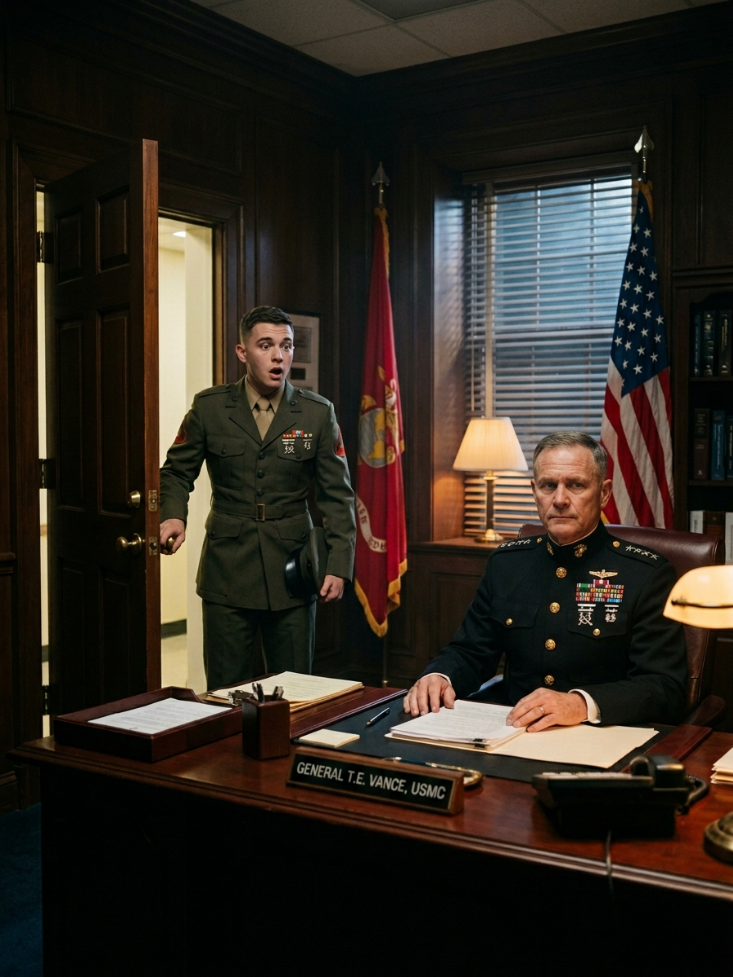
The MP opened the door and shoved me roughly inside, closing it instantly behind me. I stood perfectly still, my eyes wide, playing the role of the terrified subordinate walking into the slaughterhouse. The room was breathtakingly opulent, a monument to unchecked power, but I kept my gaze fixed on the man sitting behind the massive, antique desk. The trap was set.
Finish reading @ Part II: I thought I was just buying a broke, shivering veteran a cup of coffee and a hot meal to honor the Corps. He didn’t know the credit card decline was engineered by my cyber division so I could clone his biometric access badge when I bumped his shoulder.
About The Author