Part I: The Morning Raid and the Mailbox Accusation
The heavy, humid air of late summer hung thick over Oak Creek, a modest, working-class neighborhood where the houses were small, the paint was often peeling, and the people minded their own business while quietly drowning in mortgages. I sat by the window of my aging craftsman home, a hand resting gently on my swollen abdomen. At thirty-four weeks pregnant, sleep had become a fractured, elusive concept, replaced instead by the rhythmic, heavy thumping of my child and the suffocating stillness of the pre-dawn hours.
I was currently dressed in a faded, oversized flannel maternity robe that had seen better days, its hem frayed and its elbows worn thin. It was the perfect camouflage. To the outside world, to the neighbors, and most importantly, to the regional bank aggressively sending me foreclosure notices printed on glaring red paper, I was just another unfortunate statistic. I was supposed to be a struggling, single, expectant mother who had fallen three months behind on her payments, clinging desperately to a dilapidated house she could no longer afford.
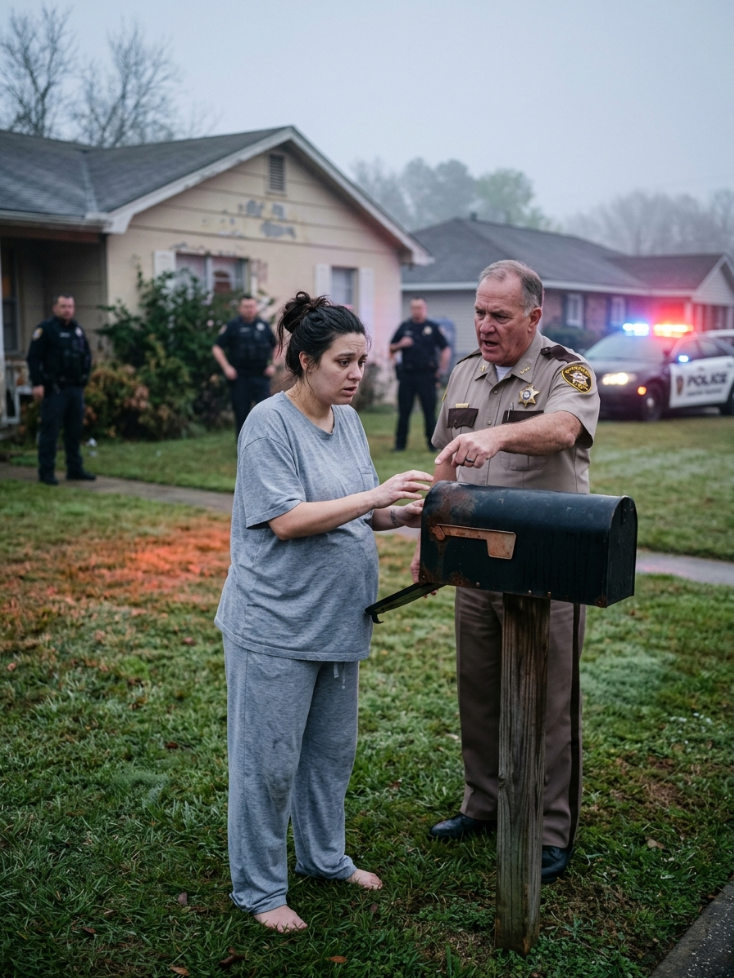
The silence of the early morning was suddenly shattered by the harsh, sweeping beams of red and blue emergency lights. They danced across my faded floral wallpaper, casting violent, spinning shadows across the living room. I pushed myself up from the armchair with a soft groan, my joints aching with the weight of the pregnancy, and made my way to the front door. The porch boards creaked familiarly beneath my bare feet as I stepped out into the cool, misty air.
parked askew on the cracked asphalt in front of my house were two police cruisers. Standing on my lawn, crushing the delicate dandelions under his heavy boots, was Sheriff Miller. His face was drawn, deeply etched with the kind of grim exhaustion that only comes from delivering terrible news before sunrise. Beside him stood three deputies, their hands resting cautiously on their duty belts, scanning my property with unnecessary intensity.
“Sheriff?” I asked, pulling the collar of my worn robe tighter around my neck against the morning chill. “What’s going on? It’s barely six in the morning.”
Sheriff Miller removed his wide-brimmed hat, pressing it against his chest. He sighed, a heavy, rattling sound. “I’m sorry to wake you, ma’am. It’s about your neighbor. Mrs. Higgins. She passed away in her sleep last night. Her home healthcare nurse found her about an hour ago.”
The words hit me like a physical blow, stealing the breath from my lungs. My hand fluttered to my chest. Mrs. Higgins was eighty-two years old, a frail but fiercely independent widow who had lived in the pale yellow house next door for over four decades. She was the soul of this crumbling street. Just yesterday afternoon, under the sweltering heat of the afternoon sun, I had spent three agonizing hours slowly pushing a rusty, sputtering lawnmower across her overgrown yard. She hadn’t been able to afford the neighborhood landscaping service for months, and her pride wouldn’t let her ask for help. I had done it out of pure, quiet kindness, wiping the sweat from my brow as she sat on her porch, sipping iced tea and telling me stories about her late husband’s days working at the local steel mill. She was a beacon of gentle warmth in a world that often felt incredibly cold.
Before I could even process the profound grief welling in my throat, before I could offer a single word of condolence or ask about funeral arrangements, the roaring, guttural snarl of a high-performance engine shattered the neighborhood’s mourning.
A sleek, metallic silver Porsche 911 Turbo tore around the corner, taking the turn far too fast. It screeched to a halt right in front of my house, the tires violently kissing the curb and sending a spray of muddy puddle water onto Sheriff Miller’s boots. The driver’s side door swung open, and out stepped a man who looked like he had been manufactured in a laboratory specifically designed to produce insufferable corporate vultures.
This was Preston Sterling.
I knew exactly who he was, even if he had no idea who I was. Preston was Mrs. Higgins’s estranged, wildly entitled nephew. He was also, entirely by design on my part, the ruthlessly ambitious Vice President of Oak Creek Regional Bank—the very institution currently attempting to rip my home away from me.
Preston slammed the Porsche door shut. He was dressed in a bespoke, razor-sharp charcoal suit that likely cost more than the average annual salary of anyone living on this street. His hair was slicked back with expensive pomade, and the suffocating, cloying scent of a thousand-dollar cologne preceded him as he marched up my walkway. He didn’t look at the house where his aunt had just died. He didn’t shed a tear. His face was contorted into a mask of pure, unadulterated disgust as he locked his predatory gaze onto me.
“Arrest her!” Preston barked, his voice sharp and nasal, cutting through the damp morning air. He didn’t even bother greeting the sheriff. He simply jabbed a perfectly manicured finger directly at my face, a heavy gold Rolex flashing ostentatiously on his wrist. “I want her in handcuffs right now, Miller! She’s a broke, pregnant squatter, and she’s been prowling around my aunt’s property for days!”
Sheriff Miller frowned, stepping between Preston and my porch steps. “Mr. Sterling, please calm down. Your aunt just passed. This woman was just informed—”
“I don’t care!” Preston interrupted, his face turning a blotchy, furious crimson. He turned his venom entirely on me, his dark eyes raking over my faded robe and my swollen belly with profound revulsion. “I know exactly who you are. You’re the deadbeat at 402 Elm. I’ve personally seen your file on my desk. You haven’t made a mortgage payment in ninety days. You’re a leech. You’re a pathetic, destitute parasite sucking the life out of my bank and my neighborhood.”
I stood perfectly still. I did not flinch. I did not raise my voice, nor did I let a single tear touch my cheek. I simply observed him, my expression entirely calm, like a scientist observing a particularly erratic, insignificant insect.
Preston, entirely unbothered by my stoicism, took a step closer, his voice dripping with venomous arrogance. “I drove by here yesterday evening. I saw you over there, sweating like a pig in my aunt’s yard. ‘Mowing the lawn,’ I’m sure. You were scoping the place out. She has antique silver in that house. She has heirloom jewelry. I guarantee you stole from a dying old woman to pay off your pathetic debts. I want her searched. I want this whole dump turned inside out.”
“Mr. Sterling, you have absolutely no proof of any of this,” the sheriff warned, his voice hardening with irritation. “This woman has been cooperative.”
“Proof?” Preston sneered, letting out a harsh, barking laugh. He pointed dramatically at the rusted metal mailbox standing at the end of my walkway. “I saw her walk over to that mailbox right after she left my aunt’s house yesterday! She was looking around all paranoid, making sure nobody was watching. She stashed something in there. Probably a diamond brooch. Open it, Miller! Make this trash open it right now if she’s so innocent!”
The deputies shifted uncomfortably. Several neighbors had begun to peek through their blinds, drawn by the commotion. The sheriff let out a long, exhausted breath and looked at me apologetically. “Ma’am, to clear this up and get him off your property… would you mind opening the mailbox?”
“Of course, Sheriff,” I replied softly. My voice was steady, utterly devoid of the panic Preston so desperately wanted to see.
I carefully navigated down the porch steps, supporting my lower back with one hand. Preston crossed his arms over his chest, a smug, victorious grin spreading across his face. He looked at me as if I were a piece of garbage that had offended him by simply existing in his sightline.
I reached the end of the walkway. The metal of the mailbox was cold against my fingertips. I flipped down the squeaky latch and pulled the lid open. My hands shook, but it wasn’t from guilt or fear; it was merely the physiological response to the biting morning cold against my thin robe.
I reached inside and pulled out the only items resting in the dark, hollow metal.
I held them up for the sheriff and Preston to see. There was no antique silver. There was no stolen jewelry. There was only a delicate, cream-colored, handwritten envelope, and a small, heavy square wrapped meticulously in aluminum foil.
Sheriff Miller gently took the envelope from my hand and opened it. He read the cursive handwriting aloud, his voice thick with emotion. “‘Dearest Elara, thank you so much for tending to my wild jungle of a lawn today. My old bones just can’t handle the mower anymore, and you are an absolute angel for helping an old woman. Please enjoy this fresh banana bread. I baked it just for you and the little one. With so much love, Beatrice Higgins.'”
A profound, suffocating silence fell over the yard. The deputies stared at their boots. The sheriff looked at Preston with an expression of absolute disgust.
Preston’s smug grin vanished, replaced for a fleeting second by shock, before his features twisted back into an ugly, hateful sneer. He was incapable of shame. Instead of apologizing for baselessly accusing a pregnant woman of robbing his dead aunt, he doubled down, his ego too massive to accept defeat.
“Pathetic,” Preston spat, adjusting his silk tie and looking at the foil-wrapped bread as if it were radioactive. “Absolutely pathetic. So you conned a senile old woman out of some baked goods instead of cash. It doesn’t change what you are.” He took a menacing step toward me, leaning in so close I could smell the stale coffee on his breath beneath the mints. “Enjoy your little victory today, trash. Because my bank is finalizing the foreclosure on this dump by Friday morning. We are locking the doors, throwing your worthless belongings on the curb, and selling this lot to a developer. Have fun raising that fatherless baby sleeping on a park bench. You are nothing.”
He turned on his heel, marching back to his silver Porsche. He slid into the driver’s seat, revved the engine obnoxiously loud, and sped away from the scene of his aunt’s death without a second glance.
I did not scream after him. I did not break down into a sobbing, hysterical mess, begging the sheriff for protection. I simply looked at the beautiful, handwritten note from Mrs. Higgins. I offered Sheriff Miller a placid, entirely unbothered smile, thanked him for his time, and gently took my banana bread back. I walked gracefully up the steps, closed my heavy oak front door, and locked the deadbolt with a resounding click.
Preston Sterling thought he was a titan of industry crushing an insignificant bug beneath his bespoke Italian leather shoes. He had absolutely no idea who was standing on the other side of that door.
Part II: The Corporate Guillotine
The moment the heavy deadbolt engaged, the facade of the helpless, struggling, destitute mother completely evaporated.
I walked past the peeling wallpaper of the entryway and stepped into my home office, located in what used to be a dusty back bedroom. Behind a heavy, soundproofed door, the peeling paint gave way to an array of high-end, encrypted server racks, secure fiber-optic lines, and a massive mahogany desk. I was not a broke squatter. I was Elara Vance. I was the elusive, notoriously private billionaire founder and CEO of Vance Capital, a monolithic, international private equity firm that controlled hundreds of billions in global assets.
Oak Creek Regional Bank—the institution where Preston Sterling strutted around as a tyrannical Vice President—was merely a tiny, insignificant subsidiary, a rounding error in a massive portfolio of regional banks that Vance Capital had acquired in a hostile buyout three years prior.
I had not moved into this humble, working-class neighborhood because I was destitute. I had moved here under an alias, purchasing this home through a shell LLC, to experience a quiet, authentic, and stress-free environment during my high-risk pregnancy, far away from the sycophants and paparazzi of the financial district. More importantly, I had intentionally let the automated mortgage payments on my “cover” identity’s house lapse. I wanted to conduct a blind, undercover stress test of my own bank’s foreclosure department. I wanted to see, firsthand, how the executive leadership treated their most vulnerable, struggling clients when they thought nobody of consequence was watching.
Preston Sterling had just given me my answer, delivered with a side of breathtaking cruelty and baseless criminal accusations.
I set the banana bread gently on my desk. I bypassed my standard laptop and reached for the encrypted, secure satellite phone resting on its charging dock. I punched in a direct sequence of numbers, bypassing all receptionists and assistants, dialing straight through to my lead corporate attorney and primary “fixer,” a man named Marcus.
The phone rang exactly once before it was answered.
“Ms. Vance,” Marcus’s deep, steady voice came through the encrypted line. “Good morning. I trust the neighborhood is peaceful today?”
“Morning, Marcus,” I replied, my voice smooth, calm, and dangerously quiet. I sank into my leather desk chair, resting a protective hand over my baby. “There has been a slight disruption. I need you to initiate a total, scorched-earth forensic audit on the Oak Creek Regional branch. Specifically, I want every single file, email, and transaction tied to Vice President Preston Sterling pulled immediately.”
“Sterling,” Marcus repeated, the sound of rapid typing echoing in the background. “I have his profile up. Standard middle-management ego. Heavily leveraged. Finances a Porsche, carries massive credit card debt to maintain a wealthy facade. What is the directive?”
“The directive is a corporate guillotine, Marcus,” I stated, staring at the flashing lights of the servers. “Fire him. Immediately. For cause. I want him terminated for violating Section 4 of our corporate ethics charter—predatory lending practices, abusive client harassment, and hostile conduct. When he is terminated for cause, all of his unvested stock options in Vance Capital are to be legally evaporated. Cancel them.”
“Understood. Fired for cause, options voided.”
“But that is not all,” I continued, my voice devoid of any emotion. “Freeze his corporate expense accounts. Cancel his company-issued black card. Seize the company car if it’s leased under our corporate umbrella. Flag his name in the central banking registry for gross financial misconduct. I want his entire career, his reputation, and his financial standing dismantled and reduced to ash before noon today. He will not foreclose on another home. He will not harass another citizen. Do you understand?”
“Loud and clear, Elara,” Marcus replied. “The auditors will be in his lobby in exactly forty-five minutes. His digital access will be severed in ten. Have a pleasant morning.”
I hung up the phone. I walked to my kitchen, sliced a thick piece of Mrs. Higgins’s banana bread, and poured myself a glass of cold milk. The trap had been sprung. Now, I merely had to wait for gravity to take effect.
The execution was flawless, silent, and absolute.
At exactly 8:15 AM, while Preston was likely yelling at an intern for getting his coffee order wrong, his computer screen suddenly went black. A red padlock icon appeared on his monitor. When he picked up his desk phone to scream at the IT department, there was no dial tone. When he angrily swiped his security badge to leave his corner office, the light flashed a harsh, unforgiving red.
At 8:30 AM, a team of six severe-looking corporate auditors in dark suits marched into the Oak Creek Regional branch. They bypassed the shocked tellers and walked straight to Preston’s office. They did not knock. They handed him a heavily legally binding termination letter, citing gross misconduct and ethical violations. When he tried to laugh them off and call the CEO of Vance Capital, the auditors informed him that the CEO was the one who had signed the order.
At 9:00 AM, Preston tried to use his corporate card to hire a lawyer. It was declined.
At 10:30 AM, a tow truck arrived in the bank’s executive parking lot. Because Preston’s silver Porsche was leased through a corporate partnership program tied directly to his employment contract, the moment he was terminated for cause, the lease was voided. The tow truck hauled the screaming metallic symbol of his arrogance away while the entire banking staff watched through the glass windows.
By 3:00 PM, Preston Sterling’s flashy, debt-financed empire was a smoking, desolate crater. Stripped of his title, his corporate backing, his luxury car, and locked out of his own heavily overdrawn checking accounts, the horrifying reality of his situation finally set in. He had insulted the wrong squatter. He had threatened the wrong pregnant woman. He had finally discovered exactly who owned the ground he walked on.
Just before sunset, as the sky over Oak Creek turned a bruised purple and the streetlights began to flicker on, there was a frantic, pathetic pounding at my front door. It wasn’t the confident, aggressive knock of a vice president. It was the frantic, scrambling scratching of a desperate rat.
I slowly walked to the door, still wearing my faded maternity robe. I unlatched the deadbolt and pulled the door open.
Preston Sterling was on his knees on my porch. He was a spectacular vision of ruin. His bespoke suit was rumpled and stained with sweat. His silk tie was torn open. His hair, previously slicked back, hung in greasy, chaotic strands across his pale, terrified face. He had walked miles to get here, his expensive leather shoes scuffed and ruined.
When he saw me, he let out a choked, hysterical sob, pressing his hands together in a posture of desperate prayer.
“Ms. Vance! Elara! Please!” Preston wailed, his voice cracking with sheer, unadulterated terror. He looked up at me with wide, bloodshot eyes. “I’m ruined! I have nothing! They took the car, they froze the accounts, the stock options are gone! I’m completely bankrupt! I didn’t know! I swear to God, I didn’t know it was you!”
I stood above him, the cool evening breeze gently rustling the hem of my robe. I looked down at his trembling, pathetic form, feeling absolutely nothing but a cold, clinical satisfaction.
“You have to call them off!” he begged, tears streaming down his face, dripping onto my porch boards. “Please, give me my job back! I’ll do anything! I apologize for what I said, I was stressed, my aunt died—you have to save me, I’m begging you!”
I let him cry for a long, heavy moment. The silence stretching between his sobs was deafening. I rested my hand on my stomach, feeling a soft kick from my baby.
I looked Preston dead in the eyes, my expression utterly serene, my voice perfectly smooth and chilled to absolute zero.
“I would love to bail you out, Preston,” I whispered calmly, echoing his exact tone from that morning. “But I’m afraid a pathetic, destitute parasite like me really needs to start preparing for life on a park bench.”
Without another word, I stepped back inside, gracefully closed the heavy oak door, and locked the deadbolt.
About The Author