Chapter 3: The Sister At The Door
Avery had always known exactly when to smile.
That was her real talent. Not dance, though my parents spent thousands pretending she was gifted. Not painting, though she covered canvases in expensive colors and called every unfinished thing a breakthrough. Not charm either, though strangers fell for her within minutes.
Avery’s talent was timing.
She knew when to cry before getting caught. When to tilt her head so my father softened. When to call my mother Mommy instead of Mom. When to touch my arm in front of relatives and say, “Claire’s just stressed,” making me look cruel before I spoke.
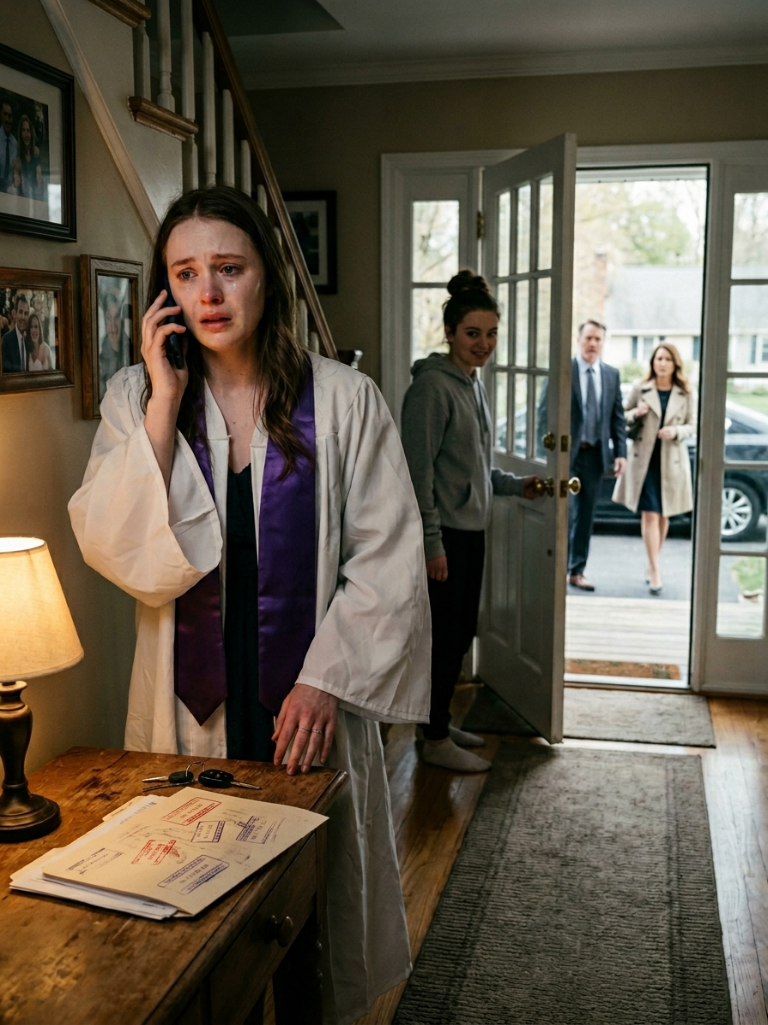
So when she stood outside my locked bedroom door that morning, she used the voice that had worked on me since childhood.
Soft.
Hurt.
Patient.
“Claire, come on. We were going to tell you.”
I almost laughed.
My knees still felt weak, but anger had begun moving through me like heat under ice.
“You were going to tell me after Dad transferred two hundred forty thousand dollars?”
Silence.
Then, lower, “It wasn’t like that.”
“What was it like?”
“Family planning.”
I shut my eyes.
Family planning.
A phrase polished enough to hide fingerprints.
On the phone, Marlene said quietly, “Ms. Mercer, do not engage extensively. I have placed full restrictions on the linked accounts. Your father is speaking with branch management now.”
My father.
At the bank.
Trying to explain why his daughter’s money should obey him.
“Is Uncle Daniel there?” I whispered.
Avery went still outside the door.
That answered before she did.
“How do you know about that?”
I did not respond.
Her voice sharpened.
“Claire, open the door.”
“No.”
The word surprised both of us.
My whole life, I had opened the door.
When Avery wanted my room because the afternoon light was better for painting, I opened it. When Mom wanted to search my closet for a blouse Avery could borrow, I opened it. When Dad wanted to sit on the edge of my bed and talk about how hard things were financially, I opened it and felt guilty for having anything at all.
No was a small word.
It felt enormous in my mouth.
Avery jiggled the knob again.
“You’re making this so much worse.”
“No,” I said. “You all did that before I woke up.”
She hit the door with her palm.
The sound made me flinch.
Then my mother called from downstairs.
“Avery? Is she coming?”
Avery stepped away from the door but did not lower her voice enough.
“She locked herself in.”
My mother sighed like I had spilled juice on the carpet.
“Oh, for heaven’s sake.”
I heard her coming up the stairs.
Marlene asked, “Can you safely exit through a window?”
I looked at the window above my desk.
Second floor. Roof slope beneath it. Old oak tree nearby.
When I was twelve, I used to climb out there at night to sit under the stars and call Grandma on a prepaid phone she gave me after Mom read my diary. I hadn’t done it in years.
“I think so,” I said.
“Take your identification, phone, and any key documents if accessible.”
My important documents were in the lockbox.
In Dad’s office.
Of course.
But Grandma’s green folder copy was in my room.
When she died, her attorney gave me a sealed envelope containing duplicate trust documents and a note in her handwriting.
Keep this where your mother does not clean.
I had hidden it behind the bottom drawer of my dresser.
My mother reached the door.
“Claire,” she said, in the voice she used at church. “Unlock this door.”
“No.”
Another silence.
Avery whispered, “She knows.”
Mom’s voice changed.
“Knows what?”
“About the bank.”
There was a breath.
Not shock.
Not outrage.
Just calculation.
Then Mom knocked gently.
“Honey, you’re misunderstanding.”
That hurt more than Avery’s anger.
Honey.
As if I were feverish.
As if the truth were something I had imagined.
“I’m on the phone with the bank,” I said.
Avery muttered something.
Mom spoke over her.
“Good. Then we can straighten this out like adults.”
“You forged my signature.”
“Don’t use dramatic language.”
“What language would you prefer?”
“We had authorization.”
“No, you didn’t.”
“You gave your father verbal permission last night.”
I stared at the door.
“What?”
“At the party,” Mom said. “You said family should celebrate Grandma’s gift together.”
I remembered the moment.
Dad had raised a plastic cup of sparkling cider in the backyard and said, “To Claire. First college graduate in the family. Grandma Eleanor would be glad her gift helped everyone get here.”
I had been tired, emotional, desperate for peace.
I said, “She loved this family.”
That was all.
They had turned five words into permission.
“You’re lying,” I said.
Mom gasped.
Avery snapped, “Don’t talk to her like that.”
I almost laughed again.
My sister had tried to steal my future before breakfast and was scolding me for tone.
Marlene’s voice came through the phone.
“Ms. Mercer, law enforcement has been requested at the branch due to an attempted disputed transfer. I strongly advise you to remove yourself from the household if you feel unsafe.”
Mom heard just enough.
“Claire,” she said, “who is that?”
I moved quickly then.
Not gracefully. Not like heroines in movies.
I stumbled in my dress, yanked open my dresser drawer, pulled it all the way out, and dropped it on the rug with a thud.
“What was that?” Avery demanded.
I ignored her.
My fingers found the taped envelope behind the wood rail.
Grandma’s handwriting.
For Claire when the room gets loud.
My vision blurred.
I shoved the envelope into my purse, grabbed my old sneakers, and climbed onto the desk.
The window stuck.
Of course it did.
My mother knocked harder.
“Claire Mercer, open this door right now.”
I pushed the window up with both hands.
Paint scraped. Wood groaned.
Avery shouted, “She’s climbing out!”
The doorknob rattled violently.
For one absurd second, I looked down at my graduation dress and thought, Grandma would be furious if I tore this.
Then I climbed through the window anyway.
The roof shingles were rough under my bare feet. Morning air hit my face, cool and damp. Somewhere below, a car door slammed. My mother screamed my name from inside the room.
I sat on the roof slope, shoved one foot into a sneaker, then the other.
My phone was still pressed between my shoulder and ear.
Marlene said, “Are you outside?”
“Yes.”
“Can you get to a safe location?”
My childhood oak tree stood close enough that its thick branch scraped the gutter. At twelve, I had thought it was a secret bridge. At twenty-two, in a wrinkled white dress with a fraud alert open on my phone, it looked like a test.
I swung one leg over.
The bark tore skin from my knee.
I climbed down like an animal, clutching branches, slipping twice, landing hard enough in the side yard that pain shot up my ankle.
Behind me, my bedroom window flew open.
Avery leaned out.
“Are you insane?”
I looked up at her.
For a moment, she was not my enemy.
She was my little sister. The girl who used to crawl into my bed during thunderstorms. The girl whose hair I braided before school because Mom was too tired. The girl who once told me I was her favorite person, before she learned that love could be used as currency.
“Avery,” I said, “why?”
Her face twisted.
Then hardened.
“Because you always get to leave.”
The words stunned me.
“I worked to leave.”
“You had Grandma.”
“You had all of them.”
Her eyes flashed toward the hallway behind her.
For one second, something naked and ugly passed across her face.
Not guilt.
Resentment.
Maybe fear.
Then Mom pulled her away from the window.
I ran.
My car was boxed in by my father’s truck, so I cut across the neighbor’s yard and headed for the only place close enough to reach on foot.
Grandma’s yellow house.
It had been sold after her death, but her old neighbor, Mrs. Patterson, still lived beside it. She was eighty-one, sharp as broken glass, and had once told my father he had “the moral posture of a wet paper bag.”
I loved her immediately.
By the time I reached her porch, I was limping, sweating, and crying so hard I could barely see.
She opened the door wearing a purple robe and holding a flyswatter like a weapon.
“Claire?”
I tried to speak.
Nothing came out.
She looked past me toward the street, then pulled me inside.
“Marlene,” I said into the phone, breathless, “I’m safe.”
Mrs. Patterson locked the door behind me.
“Bank trouble?” she asked.
I stared at her.
She nodded grimly.
“Your grandmother said this day might come.”
And just like that, I realized Grandma had not only left me money.
She had left sentries.
Chapter 4: Dad At The Branch
Mrs. Patterson made coffee strong enough to raise the dead and set it in front of me without asking if I wanted any.
Her kitchen looked exactly as I remembered from childhood. Yellow curtains. Ceramic roosters. A calendar from the feed store even though she had never owned anything larger than a housecat. Through the side window, I could see Grandma’s old house.
Not ours anymore.
A young couple lived there now. They had painted the front door sage green and planted lavender along the walkway. I should have felt happy that the house had life in it.
Instead, I felt like I was staring at the scene of a crime no one else could see.
Mrs. Patterson sat across from me and slid a box of tissues over.
“Drink,” she said.
I wrapped my hands around the mug.
“I don’t understand how they could do this.”
She raised one eyebrow.
“Do you mean morally or mechanically?”
Despite everything, a broken laugh escaped me.
“Both.”
“Moral part is easy. People take what they’ve already decided they deserve. Mechanical part, Eleanor worried about.”
I lifted my head.
“My grandma talked to you?”
“Every Thursday for thirty-six years. Usually over coffee. Occasionally over bourbon when your father visited.”
I stared at her.
Mrs. Patterson leaned back.
“Your grandmother knew Mark was pressuring you.”
“She never said it like that.”
“She was trying not to turn you against your parents. A kindness I personally found overrated.”
My phone buzzed.
Marlene.
“Ms. Mercer,” she said when I answered, “are you still in a safe location?”
“Yes. I’m with my grandmother’s neighbor.”
“Good. I need to update you. The attempted transfer was stopped. Your father is still at the branch. Local police have arrived, and our fraud department is reviewing documents.”
My grip tightened around the mug.
“And Uncle Daniel?”
“He is present.”
“Did he sign the notarized form?”
A pause.
“The form bears his notary seal.”
I closed my eyes.
So he had betrayed me.
The one person I thought might know the truth had helped them bury it.
Marlene continued.
“However, Mr. Brooks is disputing the document.”
I opened my eyes.
“What?”
“He states his seal was used without his authorization. He also states he has evidence relevant to the trust.”
Mrs. Patterson watched me closely.
“What evidence?”
“I can’t discuss details until proper verification. But Mr. Brooks has asked whether you are safe and whether you can come to the branch or your attorney’s office.”
My attorney.
I almost laughed at the phrase.
I didn’t have an attorney. I had student loans, a bruised knee, and a graduation dress with dirt on the hem.
Then Mrs. Patterson reached across the table and tapped Grandma’s envelope sticking out of my purse.
“You do,” she said.
I looked at her.
“What?”
“Open it.”
With trembling fingers, I pulled out the envelope.
For Claire when the room gets loud.
Inside were three things.
A letter.
A business card.
A key.
The business card read:
SUSAN VALE
Estate Attorney
Vale & Whitcomb Law
On the back, in Grandma’s handwriting:
She knows everything. Call her before you call family.
My throat tightened.
The key was small and brass, with a tag marked Box 19.
I unfolded the letter.
My dear Claire,
If you are reading this because your family has pressured, frightened, cornered, or confused you about money, stop explaining yourself. People who benefit from your doubt will always ask for more of it.
Call Susan. Trust Daniel more than your parents told you to. Trust Mrs. Patterson if you need a door that locks.
Your father believes family money belongs to whoever can make the most noise. Your mother believes peace is something daughters should purchase. Avery is young, but she has been watching them turn love into leverage.
Do not surrender your future to keep people comfortable in lies.
There is more you do not know. I am sorry I did not tell you while I was alive. I wanted you to finish school without carrying the whole history of this family on your back.
Box 19 has the beginning.
The rest will hurt.
But truth usually does before it frees you.
All my love,
Grandma
I pressed the letter flat on the table.
The room had gone very quiet.
Mrs. Patterson’s eyes softened.
“She always hated that she couldn’t protect you from everything.”
I swallowed hard.
“What’s in Box 19?”
“Bank safe deposit box. Susan Vale can access it with you.”
My phone, still on the call, crackled slightly.
Marlene said gently, “Ms. Mercer, Ms. Vale is actually here at the branch now.”
“What?”
“Your uncle called her before arriving.”
My mind struggled to catch up.
“Why would Dad bring Uncle Daniel if Daniel was against him?”
Mrs. Patterson’s mouth tightened.
“Because your father thought Daniel was still weak where your mother was concerned.”
The words landed strangely.
“What does that mean?”
Mrs. Patterson looked toward Grandma’s old house.
“That is Susan Vale’s story to tell.”
I changed clothes in Mrs. Patterson’s guest room.
She gave me sweatpants, a cardigan, and shoes half a size too big. I folded my graduation dress carefully and placed it in a grocery bag. The hem was torn near the knee. A brown smear marked the side where I had slid down the tree.
I wanted to cry over it.
Not because of the fabric.
Because my family had ruined the morning I had earned.
Mrs. Patterson drove me to the bank in her Buick, which smelled like peppermint and old leather. She did not ask permission to come inside.
“Eleanor told me to be a witness if necessary,” she said.
At Hawthorne Community Bank, two police cars sat near the entrance.
My father’s truck was parked crookedly across two spaces.
Seeing it made my stomach twist.
Inside, the bank lobby looked too normal. Blue carpet. Fake plant. A child eating crackers beside the coin machine. People stood in line for deposits while my life cracked open near the manager’s office.
Dad saw me first.
He was standing beside a glass-walled conference room, red-faced, sleeves rolled up, tie loosened. My father was a big man, not just in body but in atmosphere. He had always filled rooms with impatience until everyone else shrank to fit.
When he saw me, relief crossed his face.
Then anger.
“Claire,” he said, walking toward me. “Where the hell have you been?”
A police officer shifted slightly.
Dad noticed and lowered his voice.
“You scared your mother.”
I looked at him.
Of all the sentences he could have chosen.
“You tried to steal my inheritance.”
His face hardened.
“Watch your mouth.”
There it was.
The old command.
The one that had worked when I was twelve. Fifteen. Nineteen. Even twenty-one.
But I was standing in a bank lobby with Grandma’s letter in my purse and dirt still under my fingernails from escaping my own bedroom window.
“No,” I said.
Dad blinked.
Mrs. Patterson smiled faintly beside me.
Dad’s jaw tightened.
“This is family business.”
“Fraud is not family business.”
His eyes flicked to the officer, then back to me.
“You don’t understand what’s happening.”
“You opened an account with my money using my stolen documents and a forged signature.”
“Your grandmother wanted the family cared for.”
“She made a trust to keep you away from it.”
The words hit him.
Good.
A door opened behind him.
Uncle Daniel stepped out.
He looked older than I remembered. More gray. Thinner. But his eyes were the same, dark and tired and kind in a way that made my throat ache.
“Claire,” he said softly.
I stared at him.
“You notarized the form.”
Pain crossed his face.
“No. I didn’t.”
Dad spun toward him.
“Daniel, shut up.”
Uncle Daniel did not even look at him.
“I came because Mark told me Linda was in trouble and needed an old document verified. I didn’t know it involved your account until we got here.”
Dad laughed harshly.
“That’s convenient.”
Daniel reached into his coat pocket and pulled out a small black case.
“My seal was stolen from my office three weeks ago.”
Dad went still.
Daniel looked at me.
“I filed a report the same day.”
The ground beneath my father shifted. I saw it in his face.
He had brought Daniel because he thought family shame would keep him quiet.
But Daniel had brought receipts.
Then a woman in a charcoal suit stepped out of the conference room.
She had silver hair cut to her chin and eyes that looked like they had never once been fooled by tears.
“Claire Mercer?” she asked.
I nodded.
“I’m Susan Vale. I represented your grandmother.”
She held out her hand.
I shook it numbly.
“I’m sorry we’re meeting like this,” she said.
My father snapped, “Susan, this has gone far enough.”
She turned to him.
“Mark, for your own sake, stop talking.”
It was the first time in my life I had seen my father obey immediately.
Chapter 5: Box 19
We did not open Box 19 at the bank.
Susan Vale refused.
“Not here,” she said, looking at my father through the glass wall. “Not with him breathing on the windows.”
So we went to her office.
Mrs. Patterson came. Uncle Daniel came. A police officer followed separately to collect copies of documents, though Susan made it clear I was not required to make any formal statement until I had legal counsel present.
“I am legal counsel,” she said, placing a hand lightly on my shoulder. “If you want me.”
I wanted Grandma.
But Susan Vale had Grandma’s steadiness.
So I nodded.
Her office smelled like lemon polish and paper. Real paper. The kind Grandma trusted. The conference room had a long walnut table with a box of tissues in the middle, which made my stomach tighten because tissues in legal offices mean someone knows crying is likely.
Susan placed the safe deposit box on the table.
Box 19.
Small.
Plain.
Heavy.
The brass key turned with a soft click.
Inside were folders, a flash drive, two envelopes, and a photograph.
Susan removed the photograph first and slid it toward me.
It showed Grandma Eleanor standing on her porch twenty years earlier. Beside her was my mother, younger and unsmiling. My father stood near the steps, holding me as a baby.
And Uncle Daniel stood beside my mother with his hand on her shoulder.
Too close.
Too tender.
I looked up.
No one spoke.
Then I saw the back of the photograph through the paper’s faint curl.
Eleanor’s handwriting.
The day Linda chose Mark.
My mouth went dry.
“What is this?”
Uncle Daniel turned away.
Susan sat across from me.
“Claire, your grandmother wanted you to know the financial truth first. But she also left personal history because she believed your parents might use family loyalty to manipulate you.”
“My parents already did that.”
“Yes.”
My voice came out thin.
“What does Uncle Daniel have to do with Mom?”
Daniel closed his eyes.
Susan looked at him.
He nodded once.
She turned back to me.
“Before your mother married your father, she and Daniel were engaged.”
The room tilted.
“What?”
Daniel spoke, voice rough.
“It was a long time ago.”
I stared at him.
“My uncle was engaged to my mother?”
“Not by blood,” Susan said gently. “Daniel is your grandmother’s stepson. Eleanor raised him after marrying his father when Daniel was eight. Your father, Mark, was Eleanor’s biological son.”
I remembered family explanations that had always been blurry.
Uncle Daniel was “technically” Dad’s brother.
Not really.
Close enough.
Family enough when useful.
“My mother was engaged to Daniel,” I said slowly, “then married Dad?”
Daniel nodded.
“Why?”
He gave a sad, humorless laugh.
“Because your father got her pregnant.”
The words entered the room and changed its shape.
I stopped breathing.
Susan said softly, “Not with you.”
I gripped the table edge.
“Avery?”
Daniel looked down.
“No.”
Susan opened the first folder.
Inside were medical records, letters, and a birth certificate.
A name I did not recognize.
LILY MERCER.
Date of birth twenty-four years ago.
Date of death three days later.
My hands went numb.
“I had a sister?”
“A half sister,” Susan said. “Your mother and father’s first child. She died from complications related to premature birth.”
I looked at Daniel.
His face had gone pale.
“What does that have to do with the money?”
He swallowed.
“Everything and nothing.”
Susan slid a letter across the table.
“This is from your grandmother. Read when you can. I’ll summarize only what is necessary now.”
I nodded because I did not trust my voice.
“After Lily died,” Susan said, “your parents blamed the medical bills, grief, and family instability for a series of financial crises. Eleanor helped. Repeatedly. Mark borrowed against her house without her fully understanding the paperwork. Daniel discovered it and confronted him. Your mother sided with Mark, partly because she was grieving, partly because she was pregnant again soon after.”
“With me?”
“Yes.”
The room went silent.
I looked at Daniel.
His eyes were wet.
“What aren’t you saying?”
Susan’s expression became careful.
“Claire, your grandmother had reason to believe your father pressured your mother into marriage and then into a pattern of financial dependency. She also believed Mark used you, from infancy, to keep family members compliant.”
I almost laughed because the words were so calm and the meaning so ugly.
“Used me how?”
Daniel answered.
“He told us if we pushed too hard, Linda would leave with you and none of us would see you again.”
My chest tightened.
“So you left?”
“I was twenty-six and stupid and ashamed. I thought backing away would make things calmer for you.” His voice cracked. “I was wrong.”
I wanted to hate him for that.
Part of me did.
But his face looked like a man who had been punishing himself longer than I had been alive.
Susan opened another folder.
“This is the financial part.”
The documents showed a pattern that made my skin crawl.
Loans from Grandma to Dad.
Unpaid.
Credit cards opened in Grandma’s name.
Disputed.
A home equity line Grandma said she did not authorize fully.
Settlement letters.
Then later, smaller things.
A bank account opened when I was fourteen with my name listed as minor beneficiary. Closed at seventeen.
A college fund Grandma started.
Drained after Dad submitted family hardship paperwork.
My scholarship refund from freshman year.
Deposited into an account my mother controlled.
I touched the paper.
“They stole from me before.”
Susan did not soften the truth.
“Yes.”
The sentence landed like a second graduation.
A terrible one.
I had spent years thinking my life was hard because my family struggled.
But some of the struggle had been arranged.
I worked nights because my college fund disappeared. I skipped meals because “money was tight.” I took used textbooks from strangers online while my sister went to art camps and my mother told me sacrifice built character.
Grandma had known some of it.
Not all.
Not soon enough.
I pressed my hand to my mouth.
“Why didn’t she tell me?”
Susan leaned forward.
“She wanted you to finish school. She believed if you knew everything while still dependent on them emotionally, you might confront them without protection.”
Mrs. Patterson muttered, “She was right.”
The second envelope in the box had my name on it.
Susan handed it to me.
Inside was another letter from Grandma.
Claire,
I am sorry.
Those three words broke me.
Not the stolen accounts. Not the forged signature. Not my father at the bank.
Those words.
I folded over the table and sobbed like a child.
Mrs. Patterson moved first, coming around to put a hand on my back. Not smothering. Just there.
No one told me to calm down.
No one said I was dramatic.
No one made my tears inconvenient.
When I could breathe again, I read the rest.
Grandma wrote about regret. About missing signs. About believing too long that her son would become better if loved correctly. About Daniel trying to help and being shut out. About my mother choosing comfort over courage until it hardened into cruelty.
Then came the line that changed everything.
Your inheritance is not a gift, sweetheart. It is partial restoration.
Restoration.
Not favoritism.
Not selfishness.
Restoration.
The money was not Grandma choosing me over Avery.
It was Grandma trying to return what had been taken from me before I was old enough to count it.
Susan waited until I lowered the letter.
“There is one more matter,” she said.
I looked up, exhausted.
“What else could there be?”
She opened the final folder.
“Your father attempted this morning’s transfer because he received notice yesterday that the trust’s fraud monitoring provisions would expire thirty days after your graduation unless you activated your independent access.”
My lips parted.
“Yesterday?”
“During your graduation ceremony, my office emailed instructions to the address on file.”
“My email?”
Susan hesitated.
“The recovery email attached to the trust portal was your mother’s.”
The room went cold again.
Mom had seen the deadline.
They had one month before the extra protections expired.
Instead of waiting, they panicked.
Or maybe they thought graduation made me easier to manipulate.
The white dress.
The family photos.
The toast.
The pancakes.
A complete stage set for theft.
I sat back in the chair.
“What happens now?”
Susan’s eyes held mine.
“That depends on what you choose. The bank has frozen the accounts. Your father’s attempted transfer has been documented. The forged notary seal creates serious legal exposure. Your mother’s possession of your identity documents matters. Avery’s involvement may matter too, depending on what she knew and did.”
Avery.
My little sister outside the door.
Don’t be selfish, Claire.
Because you always get to leave.
I closed my eyes.
Everyone wanted something from me.
Money.
Mercy.
Silence.
Even justice felt like another demand.
Uncle Daniel spoke quietly.
“You don’t have to decide everything today.”
For once, someone said the sentence I needed.
I opened my eyes.
“No,” I said. “But I’m deciding one thing.”
Susan nodded.
“What is that?”
“I’m not going home.”
Chapter 6: The Door I Didn’t Open
My mother called forty-seven times that day.
I did not answer once.
At first, her voicemails were sweet.
Claire, honey, everyone is upset. Come home so we can talk.
Then wounded.
I cannot believe you would humiliate your father in public after everything we sacrificed.
Then angry.
You are being manipulated by Daniel and that lawyer. Your grandmother was sick at the end. You don’t know what she really wanted.
Then desperate.
Please. Avery is crying. Your father may lose his job. This could destroy us.
Destroy us.
As if they had not gathered tools at dawn and walked toward my future with signatures they stole.
Susan arranged for me to stay in a small furnished apartment owned by one of her clients for a few weeks. Mrs. Patterson brought my graduation dress, washed and folded, after convincing a police officer to accompany her to the house for my belongings.
“She was not pleased,” Mrs. Patterson said, setting down two suitcases.
“Who?”
“Your mother.”
I almost smiled.
“What did she say?”
“That I was poisoning you against your family.”
“What did you say?”
Mrs. Patterson hung her purse over her arm.
“That poison usually works slower than truth.”
I did smile then.
A little.
The days that followed were not dramatic in the way people expect.
There was no single courtroom scene where everyone confessed. No thunderstorm. No perfect speech. Just paperwork. Phone calls. Password resets. New accounts. Credit freezes. Statements. Copies. Police interviews. Long meetings where legal language turned my pain into numbered exhibits.
My father hired an attorney.
My mother sent relatives after me.
Aunt Paula called to say, “Your dad made a mistake, but criminal charges? Claire, think of the family.”
I asked, “Did you think of me when my college fund disappeared?”
She went quiet.
Then she said, “I didn’t know about that.”
“No one ever does until knowing costs them something.”
I hung up.
Avery texted on the fourth day.
You ruined everything.
I stared at the message for a long time.
Then another appeared.
I hope you’re happy now.
I typed three different responses and deleted all of them.
Finally, I wrote:
I hope someday you learn the difference between losing what was yours and losing what you were never entitled to.
She did not answer.
Two weeks later, Susan called.
“Your sister wants to meet.”
“No.”
The answer came so fast it surprised me.
Susan did not argue.
“She says she has information.”
I closed my eyes.
Of course she did.
Information is what cornered people call truth when they want a discount.
We met in Susan’s office with Daniel present.
Avery arrived wearing no makeup, which I knew was supposed to mean something. Her hair was pulled back. Her eyes were red. She looked smaller than usual, but I did not trust smallness anymore. I had seen it used as a costume.
She sat across from me.
For a while, she only stared at her hands.
Then she said, “I didn’t think Dad would take that much.”
I breathed in slowly.
“So you knew.”
Her chin trembled.
“I knew they were opening an account.”
“With my money.”
She flinched.
“They said Grandma meant for it to be family money.”
“And you believed them?”
“I wanted to.”
The same sentence people used when lies served them.
My voice stayed quiet.
“What did you do?”
Avery looked toward Susan, then back at me.
“I signed as a witness on one document.”
My stomach turned.
“You watched them forge my signature?”
Tears slipped down her cheeks.
“Mom said you had agreed but were being weird about paperwork.”
I almost laughed.
“Weird.”
“I know.”
“Do you?”
Her face crumpled.
“No. I don’t know anything anymore.”
For the first time, I saw something in her besides performance.
Fear.
Not fear of consequences, though that was there too.
Fear that the world our parents built around her had walls made of paper.
She wiped her face angrily.
“I thought you had everything,” she said.
I stared at her.
“I worked nights cleaning bedpans while you went to private lessons.”
“You had Grandma.”
“And you had Mom and Dad.”
She laughed bitterly.
“No, Claire. I had an audience.”
That silenced me.
Avery looked down.
“If I was impressive, they loved me. If I needed something, they loved me. If I made you give something up, they called it fair, and I thought that meant I mattered.” Her voice broke. “Then you graduated, and Dad said Grandma’s money would finally fix everything. My school, their debts, the house. He said you’d be fine because you’re always fine.”
I closed my eyes.
The strong one.
The fine one.
The one people rob because she can survive it.
“I wasn’t fine,” I said.
Avery nodded, crying harder.
“I know.”
I did not forgive her then.
I want to be clear about that.
Her tears did not erase my locked bedroom door. They did not erase her hand on the knob. They did not erase Don’t be selfish, Claire.
But they did make her human again.
A flawed, frightened, selfish human.
Not just a villain.
Susan asked if Avery would provide a formal statement.
Avery said yes.
That changed everything.
My father’s attorney shifted from denial to damage control within days. My mother tried to claim she had misunderstood the trust documents, but the emails recovered from her laptop showed otherwise. She had written to Dad the night before graduation:
If Claire activates access, we lose our chance. Do it before she starts asking questions.
Seeing that sentence nearly made me vomit.
My mother had smiled beside me in photos after writing it.
Dad eventually pleaded to reduced charges connected to attempted fraud and identity misuse. He lost his position at the insurance office. Mom avoided jail but received probation and community service after cooperating late and blaming everyone early. The forged notary seal became its own mess, but Daniel’s prior police report protected him.
Avery’s statement helped her avoid charges, but not consequences. Her program in Chicago withdrew its admission after the financial scandal became impossible to explain. For months, she hated me for that.
Maybe part of her still does.
I learned to stop managing that.
Restoration did not feel like victory.
It felt like cleaning a house after a fire. You save what you can. You throw away more than you expected. You cough for weeks from smoke no one else sees.
I moved into my own apartment in August, two weeks before starting my first nursing job. I bought a small gray sofa, two lamps, and a kitchen table with scratches already on it because perfect things still made me nervous.
On the first night, Daniel came over with takeout.
Uncle Daniel.
It still felt strange saying it.
He stood awkwardly in my doorway holding Thai food and a toolbox.
“I thought you might need shelves.”
“I don’t have shelves.”
“Then I brought a toolbox for emotional support.”
I laughed.
It came out rusty but real.
We ate on the floor because the table hadn’t been delivered yet. He told me stories about Grandma at twenty-five, about how she once threw a pie at a man who called her difficult, about how she loved me before I knew what love was.
Before he left, he handed me a small stack of birthday cards.
“I kept copies,” he said. “Of the ones I sent.”
My throat closed.
“They told me you stopped.”
“I figured.”
I held the cards against my chest.
“I’m sorry.”
He shook his head.
“Don’t apologize for what adults failed to protect.”
That sentence stayed with me.
Months passed.
My graduation dress hung in my closet, cleaned but not repaired. I kept the torn hem. It reminded me that I had escaped.
On Thanksgiving, my mother texted.
We’re still your family.
I looked at the message while sitting at my small kitchen table, eating mashed potatoes Mrs. Patterson had sent in a container labeled in aggressive marker: EAT ALL OF THIS.
I typed back:
Family does not get automatic access anymore.
Then I blocked her for the day.
Not forever.
Just the day.
Healing, I learned, sometimes means choosing the length of the silence.
Avery called in December.
I almost didn’t answer.
When I did, she cried before speaking.
“I got a job,” she said.
“Okay.”
“At a bakery. It’s terrible. My feet hurt.”
Despite myself, I smiled.
“Standing jobs do that.”
“I hate it.”
“I believe you.”
A pause.
Then she said, “I paid for my own bus pass.”
I closed my eyes.
It was such a small thing.
It was not enough.
But it was a beginning she had earned with discomfort, and discomfort had always been the thing our parents prevented her from surviving.
“Good,” I said softly.
She sniffed.
“I’m not asking for money.”
“I know.”
“I wanted you to know I could do one thing.”
My chest ached.
“I’m glad you told me.”
We did not become close overnight.
We may never be the sisters we could have been if our parents had loved us cleanly.
But sometimes she calls from the bakery after closing. Sometimes I answer. Sometimes we talk about nothing important. Burned croissants. Rude customers. My patients. Mrs. Patterson’s war against squirrels.
Once, Avery said, “I’m sorry I turned the knob.”
I was standing by my apartment window, watching snow fall over the parking lot.
“I know,” I said.
“Do you forgive me?”
I took a long breath.
“Not all the way yet.”
She was quiet.
Then she said, “That’s fair.”
It was the first fair thing she had ever given me.
The inheritance is still mostly untouched.
I used a little for a reliable car. A little for therapy. A little to repair my credit and replace what had been stolen before I even knew it was mine. The rest sits where only I can reach it.
Not because I worship money.
Because that money has memory.
It remembers a grandmother who saw me.
It remembers a girl in a torn white dress climbing out a window.
It remembers the morning I stopped opening doors just because family stood on the other side.
The last time I visited Grandma’s grave, I wore my graduation dress.
I had the hem repaired, but if you look closely, there is still a faint line where the tear used to be.
I placed white roses near her stone and sat in the grass.
“I finished,” I told her.
The cemetery was quiet except for wind moving through oak trees.
“I finished school. I kept the money safe. I called Susan. I trusted Daniel. I went to Mrs. Patterson. I did all of it.”
My voice broke.
“I wish you had been there.”
A leaf skittered across the stone.
ELEANOR MERCER
BELOVED MOTHER, GRANDMOTHER, AND TRUTH-TELLER
I touched her name.
For years, I thought inheritance meant what someone leaves after death.
But Grandma had left more than money.
She left a warning.
A map.
A door that locked.
A key.
And finally, when my family tried to steal my future before I had even changed out of my graduation dress, she left me the courage to whisper freeze it before they ruin me.
They didn’t ruin me.
They revealed themselves.
And when I stood up from her grave, the morning sun caught the white fabric of my dress, and for the first time since graduation, I felt exactly what I had expected to feel that day.
Free.
THE END