Chapter 3: The Papers On The Table
Lily came over the Sunday after I signed.
She did not usually visit without needing something. That sounds cruel written plainly, but grief had taught me the difference between bitterness and pattern. A bitter woman sees selfishness everywhere. A tired woman sees the calendar.
Mother’s Day, she came.
Christmas Eve, late.
Tax documents, always.
This time, she arrived with a tote bag full of lake things and a tight smile.
“Hi, Mom.”
“Hi, sweetheart.”
We stood in my doorway, two women who had once known how to hug each other.
She leaned in first. Her perfume was expensive and unfamiliar. I held her carefully, feeling the bones of her shoulders beneath her blouse. For one weak second, I wanted to ask her to stay for coffee, to sit at the kitchen table, to let me tell her everything before the world hardened around us.
But then she stepped back and glanced past me.
“Are you okay? You look tired.”
“I’m fine.”
“You always say that.”
“And you always ask after deciding the answer.”
Her eyes flicked to mine.
There. A crack.
She looked away first.
“I didn’t come to fight.”
“I didn’t know we were fighting.”
“Mom.”
I moved aside. “Come in.”
She walked into the kitchen like a guest trying not to notice dust. Her gaze landed on the folder still on the table. I had meant to put it away. Or maybe some part of me had not.
“What’s all that?” she asked.
“House paperwork.”
Her face changed immediately. Softer, interested.
“Oh. Good. Actually, that’s partly why I came.”
I poured coffee because my hands needed something to do. “Is it?”
She sat down at the table and pulled a notebook from her tote bag.
“Kevin and I made a summer schedule. It’ll be easier if everyone knows expectations.”
Expectations.
I set a mug in front of her. The same mug she had painted at age ten with a crooked yellow sun on it. She did not notice.
She opened the notebook.
“So we’ll go up the second week of June. Kevin’s parents will come that weekend and stay through July. We thought you might come June twenty-third for dinner because that’s near Dad’s birthday, and we can do something small. Not too heavy.”
I sat across from her.
“Not too heavy.”
“You know what I mean.”
“I’m not sure I do.”
She pressed her lips together. “Mom, I’m trying.”
I looked at her then. Really looked.
My daughter was beautiful in the way Ben had been beautiful when he was young, with dark hair and serious eyes. But there was a tightness around her mouth that did not belong to him or me. Kevin lived there. Elaine lived there. Years of being taught that comfort mattered more than kindness lived there.
“I know you think you are,” I said.
Her cheeks flushed. “That’s unfair.”
“Maybe.”
She tapped her pen against the notebook. “This is exactly what I didn’t want. I wanted one normal conversation.”
“Normal for whom?”
She closed the notebook halfway.
“What is that supposed to mean?”
I folded my hands around my coffee.
“It means I received your voicemail.”
Her eyes dropped.
“Mom—”
“The whole thing.”
“I was trying to set boundaries.”
“Boundaries are what you set around yourself, Lily. Not what you use to push someone out of her own home.”
Her jaw tightened. “It’s not just your home.”
There it was.
The sentence beneath all the others.
I felt strangely calm hearing it aloud.
“No?” I asked.
“You know what I mean. Dad wanted it for the family.”
“Yes.”
“And I’m his daughter.”
“Yes.”
“So why do you act like I’m some stranger trying to take it?”
I breathed in slowly.
Because strangers sometimes ask before opening cabinets. Because strangers do not move another woman’s grief out of the upstairs bedroom. Because strangers do not call themselves real family while telling a mother where she is allowed to stand.
But I did not say any of that.
Instead, I pulled one paper from the folder and turned it toward her.
She looked down.
“What’s this?”
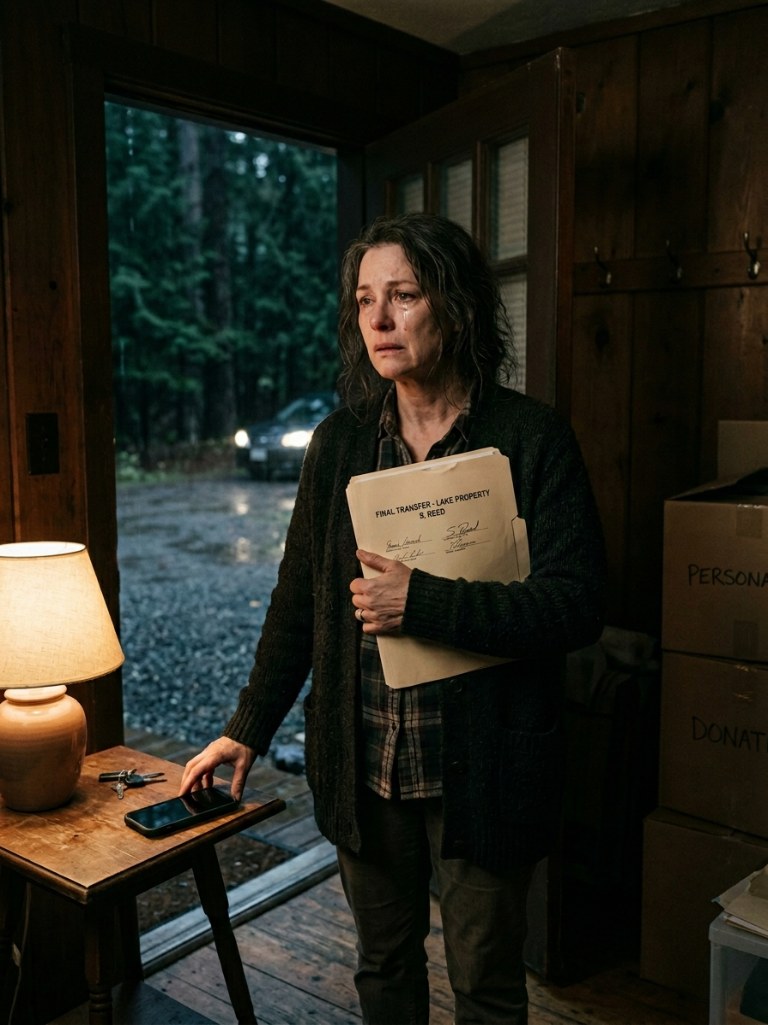
“A copy of the deed.”
“I’ve seen the deed.”
“Have you?”
Her eyes moved over the page.
The lake house was in my name.
Only mine.
Ben and I had owned it jointly. When he died, his share passed to me. Lily knew this in the vague way adult children know things that have not inconvenienced them yet. But seeing it in black ink made her quiet.
“I know it’s legally yours,” she said carefully. “That’s not the point.”
“No. It isn’t.”
“So why are we looking at this?”
I pulled out the transfer agreement but did not hand it to her.
“Because the legal part is changing.”
Her pen stopped moving.
“What do you mean?”
“I signed papers Friday.”
Her face drained so quickly I almost reached for her hand.
Almost.
“What papers?”
“The lake house is being transferred into a charitable trust.”
She stared at me.
“A what?”
“The Hawthorne Rest Fund. Your father started the idea before he died. I finished it.”
Her mouth opened, closed.
“No. Mom, no. You can’t just—”
“I can.”
“That’s insane.”
“It’s generous.”
“It’s our family house.”
“It was becoming a trophy.”
Her chair scraped back.
“That is not fair.”
“No,” I said, still calm. “What wasn’t fair was your husband discussing my home as if he were waiting for me to die. What wasn’t fair was his mother calling your father’s photograph a shrine. What wasn’t fair was you leaving me a voicemail to tell me I was no longer part of your real family.”
Her eyes filled instantly, which angered me more than I expected.
Not because she cried.
Because some part of me still wanted to comfort her.
“You’re punishing me,” she whispered.
“I’m freeing myself.”
“From me?”
The question landed between us, small and wounded.
I looked at her, and for a moment she was six again, standing in that ruined cabin with bug bites on her legs, asking if the lake had monsters.
“No,” I said. “From begging you to remember me.”
She flinched.
Then the back door opened without a knock.
Kevin walked in.
He wore boat shoes.
Boat shoes in April, in my kitchen, as if he were dressed for the property already.
“Everything okay?” he asked, but his eyes went straight to Lily’s face.
She wiped her cheeks quickly. “My mom signed the lake house into some trust.”
Kevin froze.
The mask slipped.
Not much. Just enough.
“What?” he said.
I stood. “Hello, Kevin.”
He ignored that. “What trust?”
“The Hawthorne Rest Fund.”
He gave a short laugh. “Okay, this is emotional. Let’s not overreact.”
I smiled.
That smile cost me something.
“Too late. I already signed.”
His gaze sharpened. “Without discussing it with Lily?”
“Yes.”
“She has a right—”
“No,” I said.
The word was quiet, but it cut through the room.
Kevin blinked.
I had never spoken to him like that before. I had been polite. Hostlike. Careful. The widow with the deviled eggs. The grandmother who swallowed comments for access to birthdays.
“No,” I repeated. “She does not have a legal right to property she does not own. And you do not have a moral right to property you only valued after seeing the shoreline.”
His face reddened.
Lily whispered, “Mom, stop.”
But I could not stop. Not because I was out of control, but because I had finally stepped into it.
“For years, I let you all treat that house as if it came free. Free weekends. Free groceries. Free childcare. Free memories curated by the grieving woman you found inconvenient. But nothing about that house was free. Your father worked overtime until his back gave out. I emptied retirement accounts to keep it after his medical bills. I paid taxes while you were building your life. I repaired burst pipes in February. I drove up after storms. I cleaned mouse droppings from drawers so your children could eat pancakes at a clean table.”
Lily was crying silently now.
Kevin looked at the papers.
“How final is this?” he asked.
There it was. Not “Are you okay?” Not “What did Ben want?” Not even “How could this hurt Lily?”
How final.
I turned to him.
“Very.”
His mouth tightened.
“You understand this impacts our summer plans.”
I laughed once.
It surprised all three of us.
“Yes,” I said. “I imagine it does.”
Lily looked up.
“Who are the strangers you’re giving it to?”
“Families referred through hospice programs. Caregivers. People who need rest near the end of something hard.”
Her expression changed, but Kevin spoke before she could.
“So random people get Dad’s house?”
I looked at Lily, not him.
“People who understand what it means to hold someone you love while time runs out.”
Silence.
The old refrigerator hummed. Outside, a car passed slowly over wet pavement.
Lily stood abruptly.
“I can’t talk to you right now.”
“I understand.”
“No, you don’t. You never understand anyone’s feelings but your own.”
That one hurt because it was childish and because it was familiar. Grief had made Lily cruel once before. I had forgiven it then because she was twenty-three and fatherless.
But she was thirty-nine now.
A wife.
A mother.
Old enough to know that pain does not excuse aim.
She grabbed her tote bag.
Kevin opened the door for her but paused before leaving.
“This isn’t over,” he said.
I met his eyes.
“For me, it is.”
They left without closing the door fully. A thin line of cold air entered the kitchen.
I stood there until their car pulled away.
Then I walked to the door and shut it myself.
That evening, Emma called from Lily’s phone.
“Grandma,” she whispered, “Mommy’s crying.”
My heart twisted.
“I’m sorry, baby.”
“Did you do something bad?”
I closed my eyes.
“No,” I said softly. “But sometimes grown-ups get very upset when something changes.”
“Are we still going to the lake?”
I looked at Ben’s photograph on the mantel.
“Yes,” I said. “Just not the way everyone expected.”
Behind her, Lily’s voice snapped, “Emma, give me the phone.”
The line went dead.
I stood in the quiet living room, phone still pressed to my ear.
Then I walked to the mantel and picked up Ben’s picture.
His smile was sunburned, crooked, alive.
“I tried,” I told him.
The house made its usual evening sounds around me. Floorboards settling. Pipes clicking. Wind against the windows.
And for the first time in years, I did not feel like he was disappointed.
I felt like he was standing beside me, silent and sad and proud.
Chapter 4: Strangers In The Kitchen
I did not tell Lily the transfer would not be complete for another three weeks.
That was not deceit. That was mercy wearing a hard face.
The foundation board still had to do the final walkthrough. The insurance policy had to change. The county permit for short-term charitable stays had to be approved. Volunteers were scheduled to clean and stock the pantry after Memorial Day.
Lily and Kevin, however, had stopped listening after the word trust.
They assumed anger could reverse paperwork.
It could not.
Their first move was predictable. Lily called my sister, Ruth.
Ruth phoned me the next morning in that careful voice people use when they have already chosen a side but want credit for neutrality.
“Maggie, honey, is it true about the lake house?”
“Yes.”
“Oh, honey.”
Two words. Three judgments.
I was folding towels at the time. White ones for the foundation. Soft ones, new, bought in bulk but washed twice because people facing sorrow deserved softness that did not smell like plastic packaging.
“Ruth,” I said, “I love you, but I’m not taking a vote.”
“She’s your only child.”
“I know who gave birth to her.”
“She’s hurt.”
“So am I.”
“Yes, but you’re the mother.”
There it was. The oldest trap in the world.
As if motherhood were a sentence you served without parole. As if giving life to someone meant surrendering the rest of your own. As if a daughter’s pain automatically outranked the woman she caused it to.
“I was also Ben’s wife,” I said. “And I am still a person.”
Ruth went quiet.
She had no answer for that.
Neither had I, for too many years.
After Ruth came Kevin’s email. Long. Corporate. Full of phrases like emotional decision-making and generational asset and mediation. He copied Lily, Elaine, and, absurdly, Mr. Alvarez.
Mr. Alvarez forwarded it to me with one sentence.
No response necessary.
I printed that sentence and taped it to my refrigerator.
No response necessary.
It became my prayer.
When Elaine left a voicemail saying she hoped I would “reconsider this destructive path,” I deleted it.
No response necessary.
When Robert texted that Ben would be ashamed of me, I blocked him.
No response necessary.
When Lily sent a picture of Emma and Noah on the dock from the summer before with the words They don’t understand why Grandma is taking this away, I sat down hard on the edge of my bed.
That one almost broke me.
The picture showed Emma holding a fishing pole upside down while Noah laughed with his whole face. Behind them, the lake glittered. Ben’s blue porch railing showed in the corner.
I cried for ten minutes.
Then I typed:
I am not taking love away from them. I am refusing to teach them that love means entitlement.
I stared at the message for a long time before sending it.
Lily did not answer.
The final papers cleared June seventh.
The first family arrived June twelfth.
I drove up early that morning alone.
The road to Hawthorne Lake curved through pines and birch trees, past mailboxes with peeling numbers, past the little bait shop where Ben used to buy worms and gossip. I rolled the windows down. The air smelled of sap, damp earth, and distant water.
For years, that smell had undone me.
That day, it steadied me.
At the house, volunteers were already there. June Porter from the hospice office arranged welcome baskets on the kitchen island. Mrs. Dalloway from the church stocked the freezer with casseroles. A retired nurse named Sam checked the medicine lockbox we had installed in the pantry.
The house looked different, but not wrong.
Ben’s photo stayed on the mantel.
Beside it, I placed a small framed card:
Built with love by Benjamin and Margaret Hayes. Shared in his memory for families who need a place to rest, grieve, laugh, and breathe.
I stood back and read it three times.
June touched my arm. “It’s beautiful.”
I swallowed.
“He would’ve pretended not to cry.”
“Those are the best men.”
“Yes,” I said. “He was.”
The first family arrived after lunch.
Their name was Patel. A father, Arjun, in hospice for late-stage heart failure. His wife, Meera, moved with the exhausted precision of someone who had become nurse, advocate, mother, driver, and witness all at once. Their sons were thirteen and nine. The younger one, Ravi, wore a dinosaur backpack and would not let go of his mother’s sleeve.
I greeted them on the porch.
For a second, no one spoke.
I recognized the look in Meera’s eyes. Suspicion of kindness. Fear of cost. The humiliation of needing help. I had worn that look in hospital billing offices while pretending I understood payment plans.
“There’s no charge,” I said gently. “The fridge is full. The dock is safe. The downstairs bedroom has been set up in case stairs are too much. You can call June anytime.”
Meera pressed her lips together.
Arjun looked past me toward the lake.
“Oh,” he whispered.
Just that.
Oh.
His sons saw the water and forgot, for one bright second, to be afraid.
“Can we?” the older one asked.
Meera looked at Arjun. Arjun nodded.
They ran.
Not away from grief. Toward childhood.
I gripped the porch railing.
The blue paint was warm beneath my palm.
By evening, the Patel boys were skipping stones with Sam near the dock. Meera sat on the porch wrapped in a blanket though the air was mild. Arjun dozed in a reclining chair we had placed where he could see the sunset.
I was in the kitchen labeling containers when my phone rang.
Lily.
I almost let it go.
Then I answered.
“Hello?”
At first, there was only wind. Then my daughter’s voice, sharp and breathless.
“Mom, why are there people in the house?”
I closed my eyes.
Of course.
She had gone anyway.
I pictured it easily. Lily in the passenger seat, Kevin driving too fast down the gravel road, Elaine and Robert behind them in their own car, smug with coolers and monogrammed bags, expecting to reclaim what paperwork and decency had denied them.
“Lily,” I said, “where are you?”
“In the driveway. Who are these people? There are strangers in the kitchen. Some woman just told Kevin we can’t come in.”
From the porch outside, Ravi laughed. A high, sudden burst of joy.
Lily heard it too.
Her voice cracked.
“Mom, what did you do?”
I leaned against the counter.
Behind me, the old house creaked softly, filled with someone else’s fragile hope.
“I made room,” I said.
Silence.
Then Kevin’s voice, farther from the phone but loud enough.
“Tell her to get them out.”
Lily covered the receiver badly.
“She says she made room.”
Elaine’s voice rose. “This is obscene.”
I felt something in me go very still.
“Put me on speaker,” I said.
“What?”
“Put me on speaker, Lily.”
A rustle. A beep.
Then outdoor sounds widened. Gravel under shoes. A car door slamming. Robert muttering.
I could almost see them standing there, the Callahans arranged like offended royalty, my daughter caught between blood and approval.
I spoke clearly.
“The family inside has permission to be there. You do not.”
Elaine gasped. “Margaret Hayes, how dare you speak to your daughter that way?”
“Elaine,” I said, “this conversation is not with you.”
Kevin cut in. “We drove three hours.”
“Then you have three hours to think on the way back.”
Lily made a small sound. “Mom.”
There was so much in it.
Embarrassment. Anger. Pleading. Maybe, beneath all that, fear.
I softened despite myself.
“Lily, there is a very ill man inside this house watching the lake with his children. I will not have his last peaceful week turned into a scene in the driveway.”
She said nothing.
Kevin did.
“This is still a family property.”
“No,” I said. “It is finally what Ben wanted it to become.”
“That is not true,” Kevin snapped.
I heard my daughter inhale.
“Kevin,” she whispered, “stop.”
But I was done protecting him from truth.
“Your mistake,” I said, “was thinking the secret was the house.”
No one spoke.
I looked toward Ben’s photograph in the living room.
“The secret was that Ben knew exactly what entitlement could do to love. He knew I might one day need permission to stop being used. He gave it to me before he died.”
Lily’s voice was barely audible.
“He wrote that?”
“Yes.”
Another silence.
This one different.
Wind moved across the phone. Somewhere near Lily, Noah asked, “Mommy, why can’t we go see Grandma?”
My chest tightened.
Lily said, “Not now.”
Emma’s voice followed, smaller. “Who’s sick?”
No one answered her.
I wished then that my grandchildren were not there. Anger between adults is one thing. Children hearing the shape of it is another. But Lily and Kevin had brought them, perhaps thinking their presence would soften me.
It did.
But not in the way they hoped.
“Lily,” I said, “take the children for ice cream in town. Tell them the house is helping another family this week. Tell them Grandpa Ben would be proud of that.”
Her breath shook.
“And what about me?”
The question was not angry this time.
It sounded young.
I closed my eyes.
“You can decide what kind of woman you want your children to remember.”
I ended the call before Kevin could answer for her.
My hands were shaking afterward.
I set the phone down on the counter and pressed both palms flat beside it.
In the living room, Arjun stirred.
“Everything okay?” Meera asked from the doorway.
I turned.
Her face was drawn with worry, as if she expected grief to come with eviction.
I smiled, though my cheeks were wet.
“Yes,” I said. “Everything is okay.”
That night, after the Patels went to bed, I walked down to the dock.
The moon was thin. The water moved in dark, quiet folds. Across the lake, porch lights trembled like candles.
I sat at the edge and took off my shoes.
For the first time since Ben died, I let my feet touch the water without feeling like I was waiting for him to call my name.
“You were right,” I whispered.
The lake answered the way it always had, with small waves against old wood.
Behind me, the house glowed.
Not empty.
Not stolen.
Not lost.
Full.
Chapter 5: What Real Family Leaves Behind
Lily did not speak to me for seventeen days.
I counted them despite myself.
On the first day, I told myself I was relieved.
On the second, I cleaned my linen closet until every towel edge lined up.
On the fourth, I drove past Emma’s school at dismissal time and kept going because I had not been invited and I refused to become the kind of grandmother who lurked at boundaries hoping love might escape through a side door.
On the seventh, Ruth called and apologized.
“I didn’t understand,” she said.
“No,” I said. “You didn’t.”
“I’m sorry.”
I sat in Ben’s chair, the phone warm against my ear.
“Thank you.”
On the tenth, Mr. Alvarez received another email from Kevin, this one threatening to “review all available legal avenues.” Mr. Alvarez forwarded it with two sentences this time.
Still no response necessary. Also, he has no avenues.
I laughed until I cried.
On the seventeenth day, Lily came alone.
No Kevin.
No children.
No tote bag.
She stood on my porch in jeans and an old gray sweatshirt I recognized immediately. It had been Ben’s. Then hers. She must have taken it from the lake house years ago, back when grief still made her reach for him instead of push me away.
I opened the door.
For a while, neither of us spoke.
She looked thinner. Not physically, exactly. Reduced in the way people look after a truth has moved through them.
“Can I come in?” she asked.
I stepped aside.
She walked to the kitchen and stopped near the table. The folder was gone now. In its place sat a bowl of lemons and a stack of library books.
“I didn’t bring Kevin,” she said.
“I noticed.”
Her mouth trembled.
“He’s furious.”
“I assumed.”
“He says you manipulated me. He says you waited until I was emotional and then made yourself the victim.”
I pulled out a chair but did not sit.
“What do you say?”
She looked at the floor.
“I don’t know yet.”
That was the first honest thing she had said in months.
So I sat.
After a moment, she did too.
Her hands twisted together on the table. I remembered those hands as baby fists, as sticky little palms, as teenage fingers slamming doors, as the hands that clutched mine at Ben’s funeral so hard my knuckles bruised.
“I listened to the voicemail,” she said.
My breath caught.
“What?”
“The one I left you. I forgot Kevin had saved it on his phone because he said we might need proof of what was discussed.” Her laugh was bitter and embarrassed. “Proof. Like you were a business dispute.”
I said nothing.
“I played it after we got back from the lake.” She swallowed. “I sounded awful.”
“Yes.”
She flinched, but she nodded.
“I kept waiting to hear the part where I was just setting boundaries. That’s what I told myself. That’s what he told me. But I didn’t hear boundaries. I heard…” She wiped under one eye angrily. “I heard myself trying to sound like Elaine.”
The name sat between us.
Heavy.
I had spent years wanting Lily to see it. Now that she did, I found no joy in it.
“She’s not all bad,” Lily said quickly, then stopped. “I don’t know why I defended her just now.”
“Habit.”
She gave a small, broken laugh.
“Yeah.”
Outside, a lawn mower started somewhere down the street. The ordinary sound made the kitchen feel almost unreal, like we were discussing surgery while someone trimmed hedges.
Lily looked toward the mantel in the next room.
“Did Dad really write that letter?”
“Yes.”
“Can I read it?”
I had expected anger. Demands. Maybe apology. I had not expected that.
I stood slowly, went to the living room, and opened the drawer where I kept Ben’s letter wrapped in tissue.
When I brought it back, Lily reached for it, then stopped.
“Is it private?”
“Yes,” I said. “But not from you.”
She read it at the table.
I watched her face change line by line.
At first, guarded. Then confused. Then wounded in a way that had nothing to do with me.
When she reached the part about the house becoming a cage, she pressed her fingers to her mouth.
When she reached the part about families needing a beautiful place to fall apart, tears slipped down her face and landed on the paper.
“I don’t remember this,” she whispered.
“You were sixteen when we talked about it. You were upstairs pretending not to listen.”
A memory moved behind her eyes.
“The neighbor,” she said. “Mrs. Kline.”
“Yes.”
“She wore purple scarves.”
“She did.”
“She died in October.”
“Yes.”
Lily stared at the letter.
“I remember her kids swimming. I was mad because they used my goggles.”
Despite everything, I smiled.
“You were very dramatic about those goggles.”
“I told Dad charity was annoying.”
“He said teenagers were proof humanity survived disappointment.”
For the first time in a long time, Lily laughed like herself.
Then she cried harder.
“I forgot so much,” she said.
“No. You buried it.”
She looked up.
“Is there a difference?”
“Sometimes.”
She folded the letter carefully but did not hand it back right away.
“Kevin wants me to contest it.”
“I know.”
“I told him I didn’t think we could.”
“You can’t.”
“He said that wasn’t the point. He said the point was not letting you win.”
There it was, finally stripped clean.
Not grief.
Not family.
Winning.
I saw the moment Lily heard it too.
Her face crumpled, not because of the house, but because a marriage can reveal itself slowly for years and then all at once in one sentence.
“I think,” she said carefully, “I’ve been confusing being chosen with being controlled.”
I wanted to reach for her.
I waited.
This could not be another rescue. She had to walk toward me on her own feet, not as a child carried from the wreckage.
She looked at me.
“I’m sorry.”
The words were small.
Not enough for everything.
But real enough to begin.
I nodded.
“I believe you.”
Her shoulders shook.
“I’m sorry I said real family.”
My eyes burned.
“That hurt more than you know.”
“No,” she whispered. “I think I know now.”
She reached across the table, palm up.
I looked at her hand.
Then I placed mine in it.
We sat like that for a long time.
I did not forgive her all at once. That only happens in stories told by people who want clean endings. Real forgiveness is uneven. It comes in ordinary increments. A hand held. A phone call answered. A boundary respected. A holiday survived without someone bleeding quietly in the kitchen.
But something did begin that day.
Lily started therapy two weeks later.
She told me herself, awkwardly, as if confessing a crime.
Kevin refused to go.
By August, she and the children were staying with Ruth “for a little while.” By November, the little while had become legal separation. I did not celebrate. I had learned by then that justice can still sit heavy in the room. My daughter’s marriage ending meant my grandchildren’s home changing, bedtime routines splitting, Emma asking careful questions, Noah crying for his father at inconvenient moments.
Consequences do not arrive like applause.
They arrive like bills.
Still, Lily changed.
Not perfectly. Not dramatically. But steadily.
She called before visiting. She asked about my life and listened to the answer. She brought groceries without reorganizing my pantry. She told Emma and Noah stories about Ben without making me carry all the remembering.
In September, the Hawthorne Rest Fund held its first small picnic for the families who had stayed that summer.
I almost did not invite Lily.
Then I did.
She came with the children and a pan of brownies she admitted were from a box.
The lake house was bright that day. Not polished. Not elevated. Just alive. Children ran across the lawn. Caregivers sat in folding chairs with plates balanced on their knees. A woman in a headscarf slept in the shade while her husband watched the water. June pinned name tags to people who already looked like they had known each other through some secret language of exhaustion.
Lily stood beside me on the porch, holding a cup of lemonade.
Emma and Noah were helping Ravi Patel build a tower of stones near the shore. Arjun had died in July, Meera told me quietly, but the boys had wanted to come back.
“They talk about this place like it belonged to their father,” Meera said.
I looked at Lily when she said it.
Lily heard.
Her eyes filled, but she smiled.
After Meera walked away, Lily whispered, “I thought giving it away meant losing him.”
I watched Noah hand Ravi another stone. The tower wobbled but stood.
“I did too, for a while.”
“And now?”
I looked at the house. The blue railing Ben loved. The porch he rebuilt twice because he never measured correctly the first time. The kitchen window glowing gold in late afternoon. The dock where grief and childhood kept meeting, awkwardly, beautifully, without asking permission.
“Now I think love goes bad when we try to lock it in one room.”
Lily nodded slowly.
From the lawn, Emma shouted, “Grandma! Come see!”
I went down the steps carefully. My knees were not what they used to be. Lily walked beside me, not rushing ahead, not pulling me along.
Halfway across the grass, she touched my arm.
“Mom?”
“Yes?”
She looked toward the house.
“Thank you for making room.”
The words went through me so gently I almost missed their power.
I thought of the grocery aisle. The voicemail. The cherries I never bought. I thought of Ben’s last breath in the upstairs bedroom. I thought of every nail, every bill, every insult swallowed in the name of keeping peace.
Then I looked at my daughter, who was still flawed, still learning, still mine.
“You’re welcome,” I said.
That evening, after everyone left, I stayed behind to lock up.
The house was messy in the best way. Crumbs under the table. Damp towels by the door. Fingerprints on the glass. A forgotten toy dinosaur on the windowsill.
I placed it beside Ben’s photograph.
Outside, the lake darkened to blue-black. The first stars appeared over the pines.
I stood in the doorway of the upstairs bedroom one last time before heading home. The bed was freshly made. The window was open. The curtains moved in the breeze like slow breathing.
For years, that room had been where my life ended.
Now it was only a room.
I walked downstairs, turned off the lights, and stepped onto the porch.
The house behind me settled with a familiar sigh.
Not mine.
Not Lily’s.
Not even Ben’s, not anymore.
Something better than ownership.
A promise kept.
THE END