Chapter 1: The Scent of Lemon Pledge and Betrayal
The scalding, soapy water in the imported Italian farmhouse sink had completely numbed my hands, turning my knuckles a raw, chafed red. I stood there, mechanically scrubbing the remnants of duck confit off a bone-china plate, my shoulders aching with the familiar, heavy throb of a woman who had spent the last fourteen months functioning as an unpaid domestic servant. The air in the sprawling, open-concept kitchen was thick with the suffocating scent of Lemon Pledge, expensive truffle oil, and the underlying, metallic stench of profound ingratitude. Through the massive, soundproofed glass doors leading to the formal dining room, I could hear the clinking of crystal wine glasses and the arrogant, braying laughter of my son, Julian, and his impossibly cruel wife, Camilla. They were hosting yet another intimate dinner party for Julian’s tech-startup investors—investors he only had because I had liquidated my late husband’s entire estate and sold the home I had lived in for forty years just to keep him out of bankruptcy.
I wiped a damp strand of graying hair from my forehead with the back of my wrist, letting out a slow, trembling breath. I had given him four hundred thousand euros. Every single cent of my life savings, my security, my past, and my future, freely handed over to salvage his crumbling ego and his failing company. In return, I was graciously “allowed” to live in their windowless basement guest room, provided I kept out of sight during social functions, handled the heavy cleaning their maid refused to do, and cooked meals that Camilla would subsequently critique for being “too pedestrian.” I had shrunk myself down to a ghost in my own son’s life, believing that my sacrifice would eventually be recognized, or at the very least, respected.
The heavy swinging door to the kitchen pushed open with a violent creak. Julian strutted in, wearing a bespoke navy blazer that likely cost more than my first car. His face was flushed with expensive Bordeaux and the intoxicating thrill of holding court. He didn’t look at me. He walked straight to the Sub-Zero refrigerator, yanking the heavy stainless-steel door open to retrieve another chilled bottle of sparkling water.
“Julian,” I murmured softly, turning off the running faucet so my voice could be heard over the hum of the appliances. “I finished the dessert prep. I was going to head downstairs to rest, my back is acting up again.”
Julian froze, staring into the bright, LED-lit interior of the refrigerator. He let out a long, theatrical sigh—a sound so heavy and burdened it was as if my mere existence was a physical weight pressing down on his chest. He slowly closed the door, finally turning his cold, calculating eyes upon me.
“Mom,” Julian said, his voice dropping into that flat, patronizing register he reserved for customer service representatives and me. “Camilla and I were actually just talking about this. What is your actual timeline here? Because it’s been over a year. We need the basement space to build a wine cellar before the holidays. When are you finally leaving?”
The sheer, unadulterated disrespect of the question struck me with the physical force of a slap across the face. He didn’t sound angry. He didn’t sound conflicted. He sounded entirely exhausted by the inconvenience of my survival. There was no acknowledgment of the four hundred thousand euros. There was no recognition of the fact that without my sacrifice, he would currently be facing federal fraud charges and sleeping in a hostel. To Julian, my wealth had been his birthright, and my poverty was a personal failing that was presently ruining the aesthetic of his ultra-modern mansion.
I stared at the handsome, hollow man standing before me. I looked at the imported Italian tiles beneath his feet, the designer watch strapped to his wrist, the smug, entitled set of his jaw. And then, I felt it.
Deep inside the right pocket of my stained, faded cotton apron, pressed flat against my thigh, was a small, rectangular slip of thermal paper. Three days ago, while buying groceries with the meager allowance Camilla permitted me, I had impulsively purchased a EuroMillions ticket. I had checked the numbers the following morning while scrubbing their toilets. The numbers had aligned with a statistical impossibility that felt less like luck and more like divine, cosmic intervention. Eighty-nine million euros. It was a sum of money so staggeringly massive it defied comprehension, currently burning a hole through the cheap fabric of my apron.
“Leaving?” I repeated, my voice shockingly steady, entirely devoid of the tears he was undoubtedly expecting to see.
“Yes, leaving,” Julian snapped, checking his watch with an irritated flick of his wrist. “Look, we’re not a charity, Mom. You eat our food, you use our utilities. Camilla is stressed out having you hover around all the time. Just… figure it out, okay? Start looking for subsidized housing or something. We need you out by the end of the week.”
I didn’t scream. I didn’t cry. I didn’t remind him that I had bought the very roof over his head. I simply untied the damp apron from my waist, folded it with meticulous, terrifying precision, and laid it gently on the pristine quartz countertop.
“You are absolutely right, Julian,” I said, a slow, icy smile spreading across my lips—a smile he entirely failed to interpret. “I have overstayed my welcome. Enjoy your dinner party.”
Chapter 2: The Exodus in the Rain
I did not wait for the end of the week. I did not wait for the morning. I walked past my bewildered son, leaving the kitchen and descending the narrow, uncarpeted stairs into the basement. The room they had assigned to me was little more than a glorified storage closet, smelling faintly of mildew and the expensive paints Camilla hoarded for her “artistic phases.” The air was stifling, but the oppressive atmosphere that had choked me for fourteen months had miraculously vanished. The thermal paper in my pocket was a talisman of absolute, unbridled power, radiating a heat that warmed the frozen, broken places inside my chest.
I pulled my single, battered canvas suitcase from beneath the cheap, squeaking twin bed. I packed with clinical, emotionless efficiency. I didn’t take the oversized, matronly sweaters Camilla had mockingly gifted me for Christmas. I didn’t take the cheap toiletries they bought for me in bulk. I packed only what genuinely belonged to me: a few framed photographs of my late husband before the cancer took him, my wedding band, my passport, and a small, worn copy of a novel I had been trying to read for months. I zipped the suitcase shut, the metallic sound echoing loudly in the quiet, windowless room.
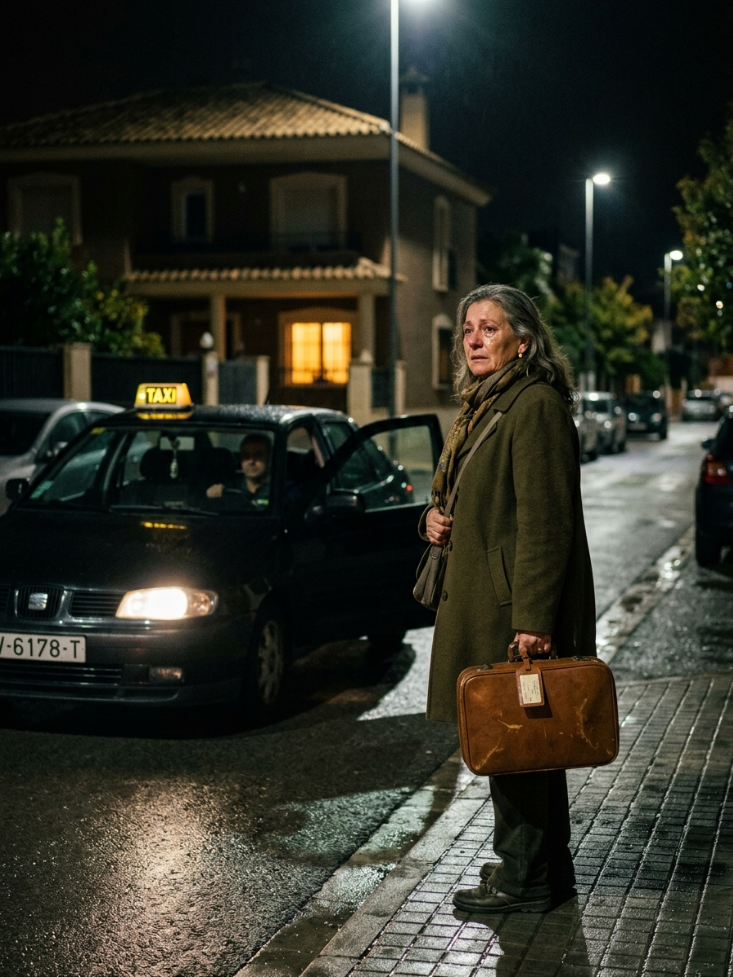
When I emerged onto the ground floor, the dinner party was in full swing. Laughter and the clinking of heavy silver cutlery drifted from the dining room. They were entirely oblivious to my departure. I walked to the heavy, custom-carved oak front door, pulled my thin trench coat over my shoulders, and stepped out into the freezing, torrential autumn rain.
The weather was dramatic, bordering on cinematic, but I barely felt the biting cold. The manicured, wealthy suburban street was lined with massive, ostentatious McMansions, their windows glowing with warm, golden light against the darkness of the storm. I stood at the end of Julian’s sweeping, circular driveway, the rain soaking my hair and plastering my clothes to my skin, waiting for the taxi I had summoned via my outdated smartphone.
I looked back at the house. Julian had designed it to be a monument to his own perceived brilliance. Massive columns, towering glass windows, a sprawling three-car garage housing vehicles he leased on credit. He was a man drowning in a sea of his own vanity, desperately treading water to maintain the illusion of extreme wealth. I knew his financial reality better than he did. I knew that his startup was burning through venture capital at an unsustainable rate. I knew he was highly leveraged, constantly taking out secondary loans to fund Camilla’s lavish shopping sprees in Paris and Milan. They were a house of cards, teetering on the edge of a precipice, and I had been the only structural beam keeping them from total collapse.
Headlights cut through the sheets of rain, and a battered yellow taxi pulled up to the curb, splashing water against the pristine stonework of the driveway. I opened the door and slid into the worn, vinyl backseat, pulling my suitcase in after me.
“Where to, lady?” the driver asked, glancing at my soaked, pathetic appearance in the rearview mirror. He clearly expected me to name a cheap motel or a bus station on the rougher side of town.
I reached into my pocket, my fingers brushing against the lottery ticket. I closed my eyes, letting the sheer magnitude of my new reality wash over me, completely erasing the subservient, broken maid I had been forced to play. When I opened my eyes, the mother who had sacrificed everything was dead. In her place sat a matriarch of unimaginable influence.
“The Four Seasons Hotel, in the city center,” I commanded, my voice projecting a smooth, authoritative timbre that caused the driver to physically jump in his seat. “The Presidential Suite. And please, step on it. I have some very important international calls to make.”
The driver didn’t argue. He threw the car into gear, and we sped away from the suffocating prison of my son’s ego. I watched the sprawling mansions blur into streaks of light through the rain-streaked window. Julian wanted me out of his house. He wanted to discard me like a broken appliance because he believed I had no further utility. He was about to learn a terrifying, catastrophic lesson about the true nature of power, and I was going to be the architect of his absolute ruin.
Continue @ Part II: I sold my family home to pay my son’s crushing debts, only for him to coldly kick me out into the street. He didn’t know the single phone call I made with my eighty-nine-million-euro winning ticket was to the offshore bank holding his remaining mortgages.
About The Author