Part I: The Ghost and the Greed
I had not touched the wrought-iron gate to our Montana ranch in thirty years, yet the moment my trembling fingers brushed the cold chain, my entire body violently remembered the day I left. My husband, James, had driven the truck in absolute silence. I had stared dead ahead, entirely hollowed out, while the dark, glittering lake behind the farmhouse swallowed the last echoed memory of my eldest son, Benjamin.
For three decades, I survived by refusing to look back. When James died six months ago, I thought the final tether to that agonizing land had been severed. My remaining children, Michael and Jennifer, certainly believed so.
Michael, a ruthless corporate liquidator, and Jennifer, a woman whose profound vanity was matched only by her terrifying credit card debt, had never cared for the ranch. They viewed my grief not as a tragedy, but as a severe inconvenience to their inheritance. At their father’s wake, before the dirt was even settled over his casket, they cornered me. Michael, wearing a bespoke Italian suit, shoved a thick binder into my hands. It was an aggressive, multi-million-dollar acquisition offer from Apex Mining. They wanted to strip the mountainside bare.
“Sell it, Mom,” Michael had demanded, his tone entirely devoid of mourning. “It’s wasted property. You’re too frail to manage it, and Apex is offering a fortune. Just sign the transfer so Jen and I can handle the adults’ work.”
Jennifer had sneered, checking her diamond-encrusted watch. “Honestly, it’s worth nothing but dirt and bad memories. Don’t be entirely selfish, Mother. Sign the power of attorney.”
I agreed to visit the property one last time before signing the papers, an act they mocked as a “pathetic, senile pilgrimage.”
But the moment I drove over the familiar rise overlooking the valley, the breath vanished from my lungs. The ranch was not an abandoned graveyard of bad memories. It was magnificently, defiantly alive.
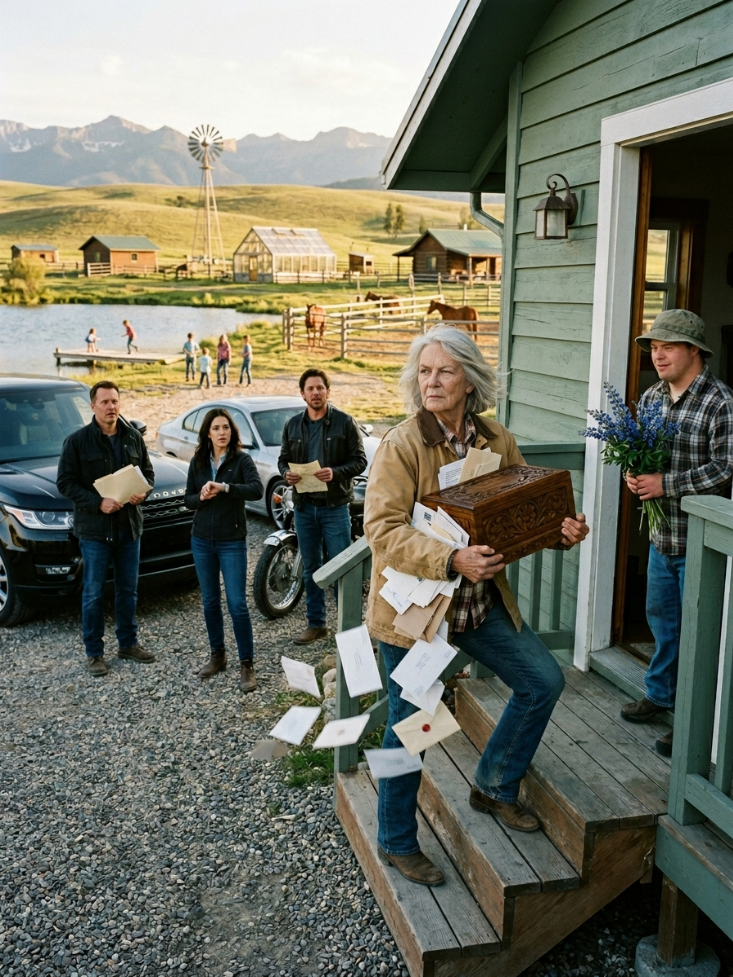
Sturdy, newly built cabins stood where barren pasture used to be. The laughter of children echoed near a bright playground. Men and women worked together to repair a tractor in the sun. Our old farmhouse had been beautifully painted, and a massive greenhouse flourished nearby.
A woman with silver in her dark hair walked toward my car before I could even open the door. “Mrs. Eleanor Mitchell,” she said with profound reverence. “I’m Margaret Santos. James asked me to be here when you finally came.”
Then, Margaret gently dismantled the lie my husband had told me for thirty years. James had not merely visited an empty property to grieve. What had started with him offering shelter to a single homeless veteran in our barn had blossomed into a sprawling, fully funded refuge for displaced veterans, battered women, and traumatized children. My husband had spent his life building an empire of healing on the exact soil where our world had ended.
Before I could fully process the shock, a man in his thirties hurried out of the farmhouse. He had Down syndrome, an open, beautifully trusting smile, and he was wearing James’s old, faded fishing hat. He stopped in front of me, holding a bundle of wild blue lupines.
“Ben’s mommy,” he whispered. “You came.”
No one had called me that in thirty years. His name was Thomas, and he explained that James had taught the children here to swim so that “no one would go to heaven too early like Ben.” James had transformed my graveyard into a sanctuary.
The roar of luxury engines shattered the sacred quiet.
Michael’s massive SUV and Jennifer’s sleek BMW aggressively tore into the dirt driveway, kicking up dust over the flowerbeds. My children threw their doors open, stalking toward me with a clipboard of transfer documents. Michael didn’t even look at Thomas or Margaret; he looked directly through them, viewing them as nothing more than insects infesting his payday.
“Mom, thank God you’re done reminiscing,” Michael barked, waving a gold pen. “These people are squatting. I’ve already called the local sheriff to clear the perimeter. Sign the Apex transfer right now. The surveyors will be here in an hour to start marking for demolition.”
Jennifer scoffed, glaring at the veterans standing near the barn. “Absolutely repulsive. Dad always was a bleeding heart for losers. Just sign it, Mother. We have a flight to catch.”
I stood perfectly still. I looked at the incredible, healing sanctuary my husband had poured his soul into. Then, I looked at the cold, hollow, deeply arrogant monsters my children had chosen to become. They expected me to weep, to crumble under their aggressive demands, to surrender my agency as I had surrendered so much else in my life.
I didn’t yell. I didn’t shed a single tear. I simply reached into the leather satchel Margaret had handed me, withdrew a separate, legally binding document bearing the crest of my late husband’s estate attorneys, and uncapped my own pen.
Part II: The Irrevocable Harvest
The quiet clinking of my silver spoon against the porcelain teacup was the only sound in the rustic mountain cafe.
It had been exactly four hours since I stood on the porch of my late husband’s sanctuary, looked into the greedy, expectant eyes of my two eldest children, and quietly slid my signature onto the irrevocable charitable trust document. I hadn’t raised my voice. I hadn’t shed a single tear. I merely handed the fully executed deed of gift back to Margaret, stepped into my sedan, and drove calmly down the mountain, leaving Michael and Jennifer standing in the dirt with their useless, unsigned corporate transfer papers fluttering in the Montana wind.
They thought they were dealing with the fragile, broken woman who had fled that land thirty years ago. They fundamentally misunderstood that thirty years of silent, agonizing grief had forged my spine out of absolute iron.
My phone, sitting on the mahogany table next to a slice of warm blackberry pie, began to violently vibrate. The screen illuminated with Michael’s name, displaying a notification badge of forty-seven missed calls and a cascade of increasingly unhinged text messages.
Mom, you cannot do this! Apex Mining just pulled out of the deal! Answer the phone, the sanctuary lawyers are threatening us with trespassing! I took a slow, deliberate sip of my chamomile tea, letting the floral warmth settle comfortably in my chest, before finally swiping right to accept the call.
“Mom!” Michael shrieked the absolute second the line connected. His voice was entirely stripped of the arrogant, commanding corporate veneer he had worn like a second skin for a decade. He sounded like a terrified, panicking child. “Tell me this is a sick joke! You didn’t just sign away a fourteen-million-dollar land deal to a bunch of homeless squatters!”
“They are not squatters, Michael,” I replied, my tone perfectly smooth and devoid of even a fraction of sympathy. “They are the legal, permanent beneficiaries of the James Mitchell Memorial Sanctuary. The deed is officially locked in an irrevocable trust. The land belongs to them now.”
“But the mining company!” Jennifer screamed in the background, having clearly forced her way onto the speakerphone. “We already signed the preliminary agreements! I took out a massive, non-refundable bridge loan against my percentage of the sale to buy that estate in Aspen! Michael leveraged his firm’s capital! If Apex walks away, we are completely bankrupt!”
I looked out the cafe window, watching the distant, snow-capped peaks of the very mountains that held my deepest sorrows and, now, my greatest pride. My husband had spent thirty years quietly paying a massive debt to the universe, and my children had eagerly attempted to pave over his beautiful legacy for a quick, bloodless payout.
“Then it appears you have both made a catastrophic financial miscalculation,” I noted calmly, adjusting my pearl earring.
“You owe us that money!” Michael bellowed, his voice cracking violently with the agonizing realization that his entire fabricated empire was collapsing in real-time. “You’re our mother! You are ruining our lives over some pathetic guilt complex! We’ll lose everything!”
“You told me the ranch was entirely worthless, Michael,” I murmured, my voice dropping to a chilling, absolute whisper that instantly silenced his frantic ranting. “I simply agreed with you. Enjoy the bankruptcy.”
I ended the call, permanently blocked their numbers, and took another bite of my pie.
About The Author